
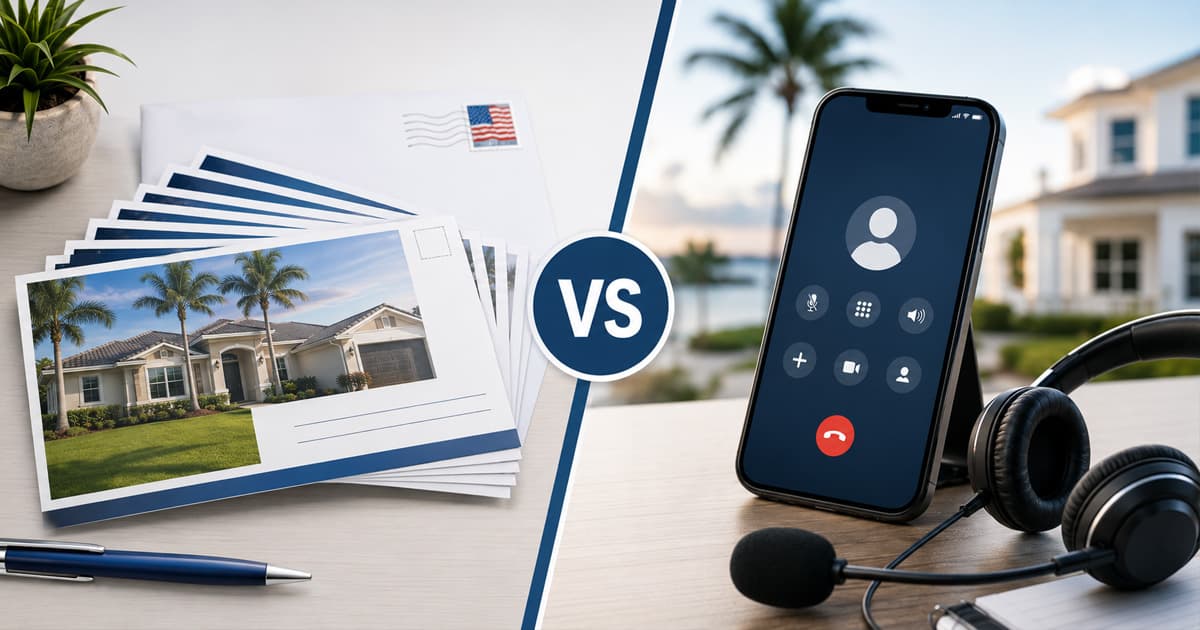
Ask ten Florida real estate investors how they reach off-market sellers and you'll hear two answers over and over: send a postcard, or pick up the phone. The direct mail vs cold calling debate is older than most of the software in your CRM, and it isn't going away — both channels still work. But they don't work the same way, they don't cost the same, and in Florida they don't carry remotely the same legal risk. This guide compares the two head-to-head for working Florida motivated seller leads — on response, cost, scale, and the compliance rules that hit the phone but never touch the mailbox — so you can decide where your next marketing dollar goes.
How direct mail reaches motivated sellers
Direct mail is a one-to-many channel. You pull a list of owners, design a postcard or letter, and the post office delivers it to a physical address. For distressed-property outreach — Florida probate leads, pre-foreclosure leads, divorce filings, tired landlords — the appeal is simple. The mail lands at the property or the owner's address of record, it doesn't interrupt anyone's dinner, and a postcard can sit on a kitchen counter for a week reminding the owner you exist.
The economics are predictable. A First-Class Mail postcard costs $0.61 in postage and a one-ounce letter $0.78 under current USPS rates; design, printing, and the list pull add a little more, and presorted bulk rates run lower still. You know your cost before you press send, and that cost doesn't change whether you mail 50 owners or 5,000. PocketLeads includes a built-in postcard editor and send, so you can mail a filtered list of leads — by county, lead type, and equity — without leaving the platform.
The trade-off is speed. Mail is patient by design. A campaign takes days to land, responses trickle in over weeks, and you're betting on volume and repetition rather than a single perfect conversation.
How cold calling reaches motivated sellers
Cold calling is a one-to-one channel. Done well, it's the fastest way to a real conversation — you can hear motivation in someone's voice, answer objections in real time, and book an appointment on the first contact. That immediacy is why wholesalers and investors have leaned on the phone for decades.
But cold calling demands two things mail doesn't. First, a phone number for every owner — and court filings and property records rarely include one, so you're relying on skip-tracing to find it. Second, labor: a human (you, an acquisitions rep, or a paid caller) has to dial, leave voicemails, and work through a list one number at a time. The cost scales with people and hours, not postage, and the only way to reach more sellers is to dial more — or hire more dialers.
Response and reach: what the data says
On raw response, direct mail has aged well while digital has eroded. The ANA/DMA Response Rate Report has consistently put direct mail's response rate in the low single digits — roughly the 2.7%–4.4% range depending on list and format — versus a fraction of a percent for email. That's a small percentage either way, which is exactly the point: lead generation is a numbers game, and the channel that wins is the one you can run consistently across a large enough list.
Cold calling is harder to benchmark honestly. Connect rates swing wildly with the accuracy of your numbers and the time of day, and most "average cold-call conversion" figures floating around are vendor marketing, not research. The defensible takeaway: both channels convert a modest share of any list, so the deciding factors aren't a magic response-rate number — they're cost, scale, and risk.
Cost per contact: postage vs labor
This is where the two channels diverge most clearly. Direct mail's cost is a known, fixed number per piece — postage plus print — and it doesn't rise with your time. Cold calling's cost is mostly labor, and labor is the most expensive and least scalable input in any outreach operation. A mail campaign to 2,000 owners costs roughly the same in effort as a campaign to 200; a calling campaign to 2,000 owners costs ten times the dials, voicemails, and hours.
There's a hidden cost on the phone side, too: bad numbers. Even good skip-tracing is never a 100% match, so a meaningful slice of every calling list is disconnected lines, wrong owners, or a number that rings a relative. You pay for those dials in time whether or not they reach the seller.
| Factor | Direct mail | Cold calling |
|---|---|---|
| Reach model | One-to-many | One-to-one |
| Cost driver | Postage + print (fixed per piece) | Labor / hours (scales with people) |
| Needs a phone number? | No | Yes (skip-tracing, never 100%) |
| Do Not Call Registry | Does not apply | Must scrub within 31 days |
| Calling-hours limit | None | 8 a.m.–9 p.m. local time |
| Consent for automation | Not required | Prior express written consent |
| Florida FTSA exposure | None | $500–$1,500 per violation |
| Best for | Wide, repeatable, low-risk reach | Fast, warm, consented conversations |
The compliance gap: why the phone is riskier in Florida
Here's the difference most investors underestimate. Real estate cold calling laws are real, enforced, and stacked against unsolicited phone outreach — while direct mail is almost entirely unregulated by comparison. If you're going to dial Florida sellers, you're operating inside three overlapping rulebooks.
The National Do Not Call Registry. Under the FCC's TCPA rules, you may not place telemarketing calls to a residential number listed on the national registry, and those registrations are "honored indefinitely" (47 CFR 64.1200(c)(2)). The FTC's Telemarketing Sales Rule gives callers a safe harbor only if they've scrubbed their list against a version of the registry obtained within the prior 31 days (16 CFR 310.4(b)(3)(iv)). Translation: you have to buy and re-scrub the list every month, and even then a registered seller is off-limits.
Calling hours. The same rule bars telemarketing calls "at any time other than between 8:00 a.m. and 9:00 p.m. local time at the called person's location" (16 CFR 310.4(c)). The mailbox has no business hours.
Consent for automation. The moment you use an autodialer or a recorded/AI voice for a telemarketing call or text to a cell phone, federal law requires prior express written consent — "an agreement, in writing, bearing the signature of the person called" (47 CFR 64.1200(a)(2), (f)(9)). You can't get that from someone you've never spoken to.
Florida's mini-TCPA — the one with teeth. The Florida Telephone Solicitation Act (F.S. 501.059) layers a state law on top. It bars an unsolicited telephonic sales call that "involves an automated system for the selection and dialing of telephone numbers or the playing of a recorded message … without the prior express written consent of the called party" (501.059(8)(a)). And it hands the recipient a private right of action: an aggrieved party can "recover actual damages or $500, whichever is greater" per violation, trebled to as much as $1,500 for a willful or knowing violation (501.059(10)). A 2023 amendment (HB 761) narrowed the trigger to systems for the "selection and dialing" of numbers and added a 15-day window to stop after a recipient texts "STOP" — but the core exposure remains: every non-compliant call or text is its own statutory claim, and Florida has been a magnet for FTSA class actions.
Now the other column. Direct mail is not a "telephonic sales call." There is no federal Do-Not-Mail registry with a private right of action, no consent requirement to put a postcard in someone's box, no calling hours, and no $500-per-piece statutory damages. (A voluntary mail-preference opt-out exists, but it carries none of the legal teeth of the phone rules.) That asymmetry — strict, expensive, litigated rules on one channel and almost none on the other — is the single biggest reason to think hard before you make the phone your first move.
When to use each — and how to combine them
The smartest Florida operators don't pick one channel. They sequence them, and the legal asymmetry above is exactly why. Lead with compliant direct mail to a filtered list of fresh filings. The owners who are genuinely motivated call you back, reply, or fill out a form — and the moment a seller reaches out, the conversation flips from a cold outbound call (the kind DNC and the FTSA police) into a warm, consented inbound one. You sidestep the riskiest part of phone outreach entirely, and you spend your calling hours on people who've already raised their hand.
Deliverability reinforces the order. Mail goes to the verified owner or property address of record; phone outreach rides on skip-traced numbers that are never a perfect match. So mail is your wide, reliable net, and the phone is your sharp tool for the leads the net already surfaced. An investor working Lee County motivated seller leads might mail every new probate and pre-foreclosure filing weekly, then call only the owners who respond — and even then, scrub against the Do Not Call list first. For a deeper, step-by-step version of the mail side, see our direct-mail playbook.
The bottom line
Direct mail wins on cost predictability, scale, and — by a wide margin — legal safety. Cold calling wins on speed and the quality of a live conversation, but it carries real compliance risk in Florida and a labor cost that doesn't scale. For most investors, the answer to "direct mail vs cold calling" isn't either/or: mail first to reach everyone cheaply and safely, then call the sellers who answer. The channel you can run consistently, affordably, and without a lawyer on speed dial is the one that compounds.
Frequently asked questions
Is cold calling legal for real estate investors in Florida?
Yes, with conditions. You must scrub your list against the National Do Not Call Registry (and re-scrub within 31 days), only call between 8 a.m. and 9 p.m. local time, and obtain prior express written consent before using an autodialer or recorded/AI voice. On top of the federal TCPA, Florida's FTSA (F.S. 501.059) lets recipients sue for $500–$1,500 per non-compliant call or text, so manual, list-scrubbed, consent-aware dialing is essential.
Do Do Not Call rules apply to direct mail?
No. The National Do Not Call Registry and the TCPA govern phone calls and texts, not postal mail. There is no federal Do-Not-Mail registry with a private right of action, which is a large part of why direct mail carries far less legal risk than cold calling.
What response rate should I expect from direct mail to motivated sellers?
Plan for the low single digits. The ANA/DMA Response Rate Report has consistently shown direct mail responding in roughly the 2.7%–4.4% range depending on list and format — well above email. Distressed-seller niches like probate or pre-foreclosure can run higher or lower, so judge it by cost-per-deal across a full campaign, not a single mailing.
How much does it cost to mail a postcard to a lead?
Postage for a First-Class Mail postcard is $0.61 and a one-ounce letter is $0.78 at current USPS rates, with design and printing on top and lower presorted bulk rates available at volume. The cost is fixed per piece and doesn't rise with your time — unlike phone outreach, where labor is the dominant expense.
Should I use direct mail or cold calling first?
Mail first, then call. Direct mail reaches every owner cheaply and without the phone's compliance exposure; when a motivated seller responds, you can call them as a warm, consented inbound contact instead of a cold outbound one. This sequence keeps your calling hours focused on people who've already shown interest.
Work fresher leads in both channels
Whatever channel you choose, the campaign is only as good as the list behind it. PocketLeads delivers court-verified Florida motivated seller leads — probate, pre-foreclosure, divorce, and eviction filings — the same day, enriched with property and equity data and ready to mail or call from one platform. Get Started Free and put your next campaign on fresh filings.