
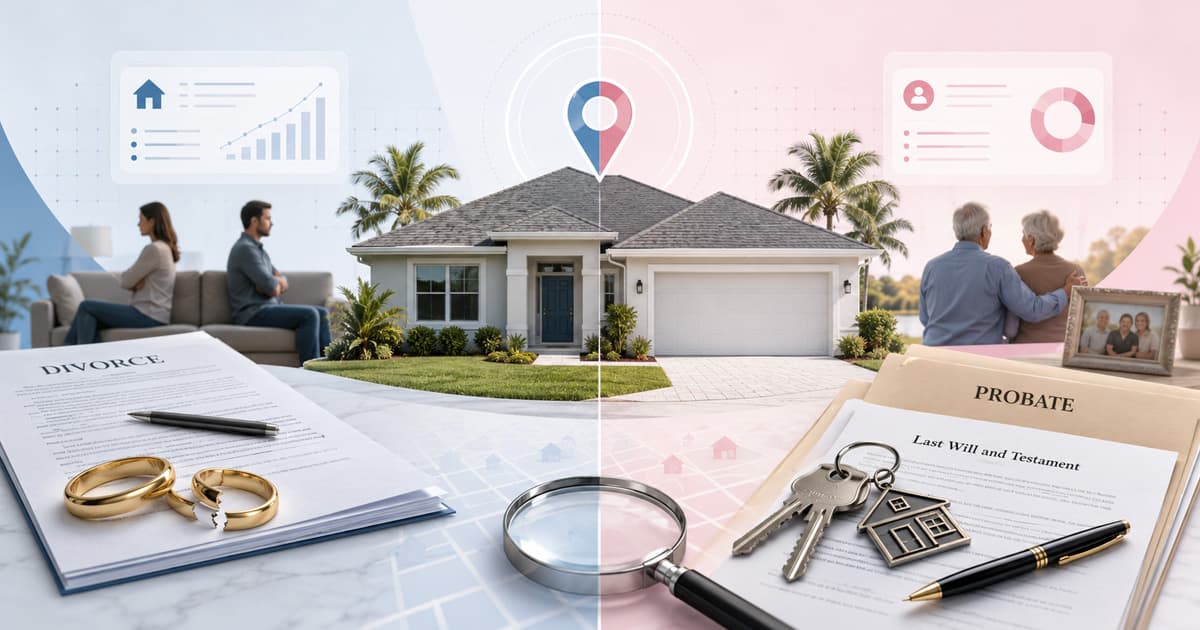
If you buy houses from motivated sellers in Florida, two lists dominate the conversation: divorce filings and probate filings. The honest comparison of divorce vs. probate leads isn't about which one is "better" — it's about which one fits the way you actually buy. One list starts with a couple dividing assets they no longer want to share. The other starts with a family settling the estate of someone who has died. Both routinely produce real property that needs to be sold, but the seller, the timeline, and the equity look almost nothing alike.
This guide puts Florida divorce leads and Florida probate leads side by side on the five things that actually change your numbers — and ends with a simple framework for deciding which to work (or whether to work both).
Two life events, two very different sellers
A divorce is a forced negotiation between two living owners. Florida is a no-fault state — the only ground required is that the marriage is "irretrievably broken" (Fla. Stat. § 61.052) — and the court divides marital property under equitable distribution, which "must begin with the premise that the distribution should be equal" (§ 61.075). When the largest shared asset is the marital home and neither spouse can afford to keep it alone, the practical answer is often to sell and split the proceeds. Your seller is the couple themselves — frequently still living in the property, and sometimes not agreeing on anything.
Probate begins with a death. The estate has to be administered before its real property can be transferred or sold, and the people making the decision are the personal representative and the heirs — often adult children who live somewhere else and have just inherited a house they never planned to own. The home may sit vacant. The motivation is rarely emotional attachment; it's the practical weight of maintaining, insuring, and eventually liquidating a property from a distance.
Filing volume: Florida has nearly as many divorces as probates
Both lists are big — and remarkably close in size. According to the Florida Office of the State Courts Administrator's Statistical Reference Guide for FY 2024-25, Florida courts logged roughly 70,000 of each in a single year:
| Florida court filings, FY 2024-25 (statewide) | Filings |
|---|---|
| Dissolution of marriage (divorce) | 72,735 |
| Simplified dissolution (uncontested) | 12,261 |
| Probate — estate cases | 67,808 |
| Probate — full category | 73,282 |
The takeaway isn't the rounding — it's the parity. Divorce and probate are two of the largest recurring sources of motivated seller leads in Florida, and neither is a niche. Across PocketLeads' four active counties — Collier, Lee County motivated seller leads, Sarasota, and Pinellas County motivated seller leads — the same year produced 11,414 probate filings and roughly 11,800 dissolution-of-marriage filings. Two deep, refreshing pools, side by side, in the same four counties.
Who you're actually contacting (and where they live)
This is where the lists diverge in a way that changes your scripts. With divorce, the people who can say "yes" usually still live in (or just left) the house, and there are two of them — which means two sets of expectations and, often, two different ideas about price. Your mailing address and the property address are frequently the same.
With probate, the decision-maker is the personal representative, who may live in another state entirely. The property address and the contact address are often different, the home may be empty, and you're frequently talking to one person acting on behalf of the estate rather than two spouses negotiating against each other. Accurate contact data matters more here, and skip-tracing — which is never a 100% hit rate on any list — does more of the heavy lifting.
Timeline: how soon the property can reach the market
"Filed" does not mean "for sale." On the divorce side, no final judgment of dissolution can be entered until at least 20 days after the petition is filed (§ 61.19) — but that's just the floor. A contested case with a disputed house can run for months, and the property might sell during the proceedings or only after the judgment. The filing is an early signal; the sale can lag it considerably, and the lag is driven by how much the spouses fight.
Probate runs on a more defined statutory clock. The estate generally has to clear a creditor period — claims are barred unless filed by the later of three months after the first publication of the notice to creditors or 30 days after service (§ 733.702) — and formal administration commonly takes several months to a year. Smaller estates can use the faster summary administration track, available when the estate (less exempt property) doesn't exceed $75,000, or when the decedent has been dead more than two years (§ 735.201). That threshold doubles to $150,000 on July 1, 2026 under CS/SB 1500 (for deaths on or after that date), which will pull more estates into the quicker path.
Equity: why probate homes skew free-and-clear
Here's the structural difference that matters most to your offer math. Probate sellers are often settling the homes of older owners who paid off their mortgages years ago. Across PocketLeads' own data in Collier, Lee, Sarasota, and Pinellas counties, roughly 6 in 10 of those estate homes are owned free and clear — no active mortgage at all. That combination — high equity plus a motivated heir who often doesn't live there — is exactly what makes probate the more "investor-shaped" list, and it isn't close.
Divorce homes are almost the mirror image: only about 2 in 10 are free and clear. The owners are typically still working-age, so the property more often carries an active mortgage, and any equity is being split between two parties rather than sitting unencumbered. That doesn't make divorce a weak list — the motivation is real, because equitable distribution frequently forces the sale (§ 61.075) — but the deal is more likely to be a market-priced transaction than a deep-equity buy. If your model needs a large equity cushion, weight toward probate. If you're comfortable on or near retail (or you list rather than buy), divorce holds up well.
Competition: how each list gets worked
Probate is one of the most established niches in real estate investing, which is a double-edged sword: the equity is attractive, but the personal representative may be getting mail from a dozen investors at once. Winning there is about timing and accuracy — reaching the right contact early, with correct information, before the pile builds. That's why probate skews toward high-volume direct mail and cold outreach, and why it's a natural fit for PocketLeads for wholesalers.
Divorce draws fewer dedicated investor-mailers and more real estate agents, because the marital home is often headed for a conventional listing. If you hold a license, divorce can be the friendlier list — you're offering representation, not just a cash number. Either way, speed is the edge: PocketLeads surfaces both types the same day, while many sources work from data that's already weeks old.
Which should you work? A simple decision framework
Use this as a starting point, not a rulebook:
- Lean probate if you want high-equity, often-vacant properties with a single decision-maker, you buy below retail, and you can mail or call at volume. Going deeper on the estate side? See our breakdown of pre-probate vs probate leads.
- Lean divorce if you're an agent (or list-friendly), you're comfortable transacting near market value, and you'd rather work with owners who are still on site. Our Lee County divorce leads guide shows what that looks like at the county level.
- Work both if you have the capacity. The two lists peak independently, they reach the same four Florida counties, and on PocketLeads each lead type is its own subscription — so you can add the second only when you're ready to work it.
There's no universally "better" list. There's the list that matches your buy box, your channel, and your appetite for competition — and for a lot of Florida investors, the right answer is to run both side by side and let the deals decide.
Start working Florida divorce and probate leads
PocketLeads delivers court-verified divorce and probate leads across Collier, Lee, Sarasota, and Pinellas counties — enriched with owner contact, property, and equity data, the same day. Get Started Free and pull your first list today.
Frequently asked questions
Are probate or divorce leads better for real estate investors?
Neither is universally better. Probate leads skew toward high-equity, often-vacant homes with a single decision-maker, which suits cash buyers and wholesalers. Divorce leads involve living, on-site owners and are friendlier to agents and near-retail transactions. The right choice depends on your buy box and outreach channel.
How many divorce and probate cases are filed in Florida each year?
In fiscal year 2024-25, Florida courts logged 72,735 dissolution-of-marriage filings (plus 12,261 simplified dissolutions) and 67,808 probate estate filings statewide, according to the Florida OSCA Statistical Reference Guide — roughly 70,000 of each.
How long before a probate or divorce property can be sold?
A divorce can't reach final judgment until at least 20 days after filing (§ 61.19), and contested cases often take months. Probate generally must clear a creditor period — the later of three months after notice is published or 30 days after service (§ 733.702) — and formal administration commonly takes several months to a year; smaller estates can use the faster summary-administration track.
Do divorce and probate properties have equity?
Probate homes skew heavily free-and-clear — in PocketLeads' data across Collier, Lee, Sarasota, and Pinellas, roughly 6 in 10 carry no active mortgage, versus only about 2 in 10 divorce homes. Probate therefore tends to leave more equity to work with, while divorce homes more often transact closer to market value.
Where do divorce and probate leads come from?
Both are sourced from public records filed in Florida county courts. PocketLeads surfaces new filings the same day and enriches them with owner contact, property, and equity data so they're ready to work.