
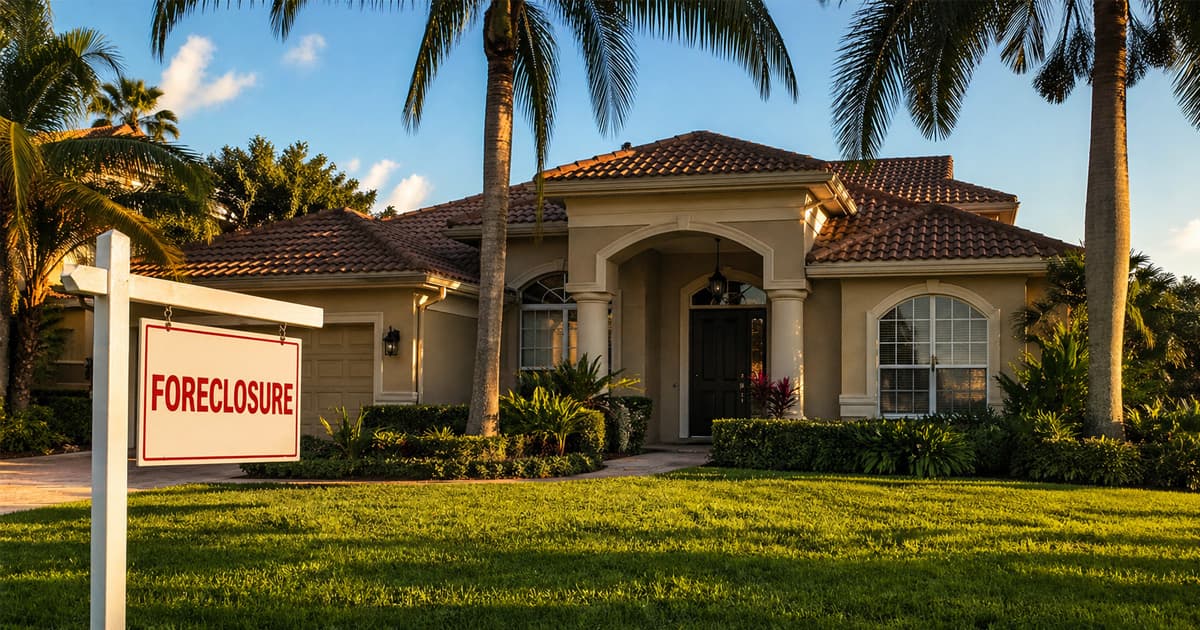
Florida ranked #1 in the nation for foreclosure rate in October 2025 — one filing for every 1,829 housing units, the worst of any state. By Q1 2026, Florida ranked third nationally with one foreclosure filing for every 750 housing units — a rate 61% higher than the U.S. average of one in every 1,211 units.
This is not a temporary spike. Florida's foreclosure pipeline has grown for over a year, driven by four converging pressures specific to this state. For real estate investors in Southwest Florida, the data reveals a clear picture of where the market is heading — and why acting early matters.
Florida's Foreclosure Numbers: What the Data Shows
According to ATTOM's Q1 2026 U.S. Foreclosure Market Report, published April 16, 2026, Florida sits near the top of the national foreclosure story.
Metric | Florida — Q1 2026 | vs. National |
|---|---|---|
Foreclosure Rate | 1 in every 750 housing units | 61% higher than U.S. avg (1 in 1,211) |
Foreclosure Starts | 10,099 in Q1 2026 | #2 nationally (behind Texas only) |
Bank Repossessions (REOs) | 1,014 (up from 487 in Q1 2025) | +108% year-over-year |
National Ranking | #3 worst foreclosure rate | Behind Indiana and South Carolina only |
The bank repossession figure stands out. Florida's REOs increased 108% year-over-year — more than double the national REO increase of 45% over the same period. Lenders are completing foreclosures in Florida at a rate that outpaces nearly every other state in the country.
"While volumes remain below historical peaks, the continued rise — especially in starts and bank repossessions — suggests financial pressure may be building for some homeowners and could signal shifting housing market dynamics," said Rob Barber, CEO of ATTOM.
Important context: these numbers, while rising sharply, are still well below the foreclosure crisis of 2007–2012. This is a market normalizing after years of pandemic-era forbearance programs — not a crash.
Why Are Foreclosures Rising in Florida?
Four specific factors explain why Florida's foreclosure numbers are outpacing the national trend.
1. The Forbearance Hangover
During the COVID-19 pandemic, mortgage servicers offered widespread forbearance programs that allowed homeowners to pause or reduce payments. Those programs ended years ago, but the downstream effects are still working through the system.
"The restructuring of loss mitigation that has reduced the number of options offered has revealed this weakness," said Donna Schmidt, president and CEO of DLS Servicing, speaking to HousingWire. "I expected to see five years of normal foreclosure activity get condensed and forced through the system in the next two years. This is just the start."
2. Florida's Insurance Cost Crisis
Homeowners insurance in Florida now runs between $3,240 and $4,500 per year depending on location, home value, and roof age — among the highest rates in the country. The national average stands at $2,370 per year, itself up nearly 70% over the past five years.
For Florida homeowners who purchased at 2021–2022 prices with low down payments, the combination of a mortgage payment, insurance premiums, property taxes, and HOA fees has pushed total ownership cost well beyond what many household budgets can sustain.
3. The COVID Price Reversal
Florida home values surged dramatically during the pandemic. Many of those gains are now unwinding — and that creates a specific trap for overleveraged homeowners.
"Florida saw a huge surge in home prices during COVID and those gains are being reversed," Schmidt told HousingWire. "Borrowers who find that their homes are now unaffordable cannot sell their properties and completely satisfy their liens."
When a homeowner can no longer afford the payments but also cannot sell for enough to cover what they owe, foreclosure becomes the only resolution. That is the dynamic playing out across the state right now.
4. Interest Rate Resets
Homeowners who took out adjustable-rate mortgages during the low-rate environment of 2020–2022 are now seeing those loans reset to current rates. For buyers who already stretched to afford a home at peak prices, a payment increase of several hundred dollars per month can tip an already-fragile budget into default.
Southwest Florida Is a National Hotspot
Within Florida, Southwest Florida has emerged as one of the most concentrated foreclosure regions in the country. ATTOM's Q1 2026 data identifies two Florida metros among the top two worst in the entire nation:
Lakeland, FL — 1 foreclosure filing for every 409 housing units (#1 worst nationally)
Punta Gorda, FL — 1 foreclosure filing for every 416 housing units (#2 worst nationally)
Punta Gorda sits in Charlotte County — directly adjacent to Lee County, one of the markets PocketLeads covers. The pressures driving Charlotte County's numbers (insurance costs, COVID price reversal, rate resets) apply equally across the Cape Coral and Fort Myers market.
Not every Southwest Florida county is equally affected. Collier County, as of mid-2025, showed a foreclosure rate of approximately one in every 1,045 housing units — elevated from a year prior but more resilient than the statewide average. Over 57% of Collier home purchases are made in cash, and the county's median household income of $118,000 (versus $67,000 statewide) provides a buffer that other counties do not have.
The pattern is consistent: affordability-driven foreclosures are concentrated in the markets where buyers stretched the most during the COVID price surge. That is where the leads are.
What This Means for Real Estate Investors
Foreclosure filings are the early signal investors pay attention to — not the auction. Florida is a judicial foreclosure state, and the process takes an average of 671 days from filing to completion. That window is where the opportunity is: sellers who have just received a lis pendens notice are motivated, often open to creative solutions, and not yet fielding calls from every investor in the market.
A few important distinctions about the current environment:
These are affordability-driven events, not value-driven. Unlike 2008, most of these properties still carry equity. Homeowners are defaulting because they cannot sustain the all-in cost of ownership — not because the home is worth less than what they owe. That creates more room to structure a workable deal for both sides.
The pipeline is growing. With foreclosure starts up and timelines shortening, the supply of pre-foreclosure leads in Florida will continue to increase through 2026. Positioning now captures the full benefit of this trend.
First contact wins. In a rising foreclosure environment, outreach to distressed sellers increases as more investors enter the space. The investors who make contact within days of a filing — not weeks — have a decisive advantage.
This is not 2008. But for investors who understand the data and have systems to act on it early, the current Florida market is creating a real volume of actionable opportunities.
Get Pre-Foreclosure Leads the Day They're Filed
PocketLeads monitors Florida court filings every day — in Collier, Lee, Sarasota, and Pinellas counties. When a foreclosure notice is recorded, it hits your dashboard the same day, skip-traced with contact information and enriched with property data, equity estimates, and mortgage history.
No spreadsheets. No manual research. No waiting a week for a data export.