
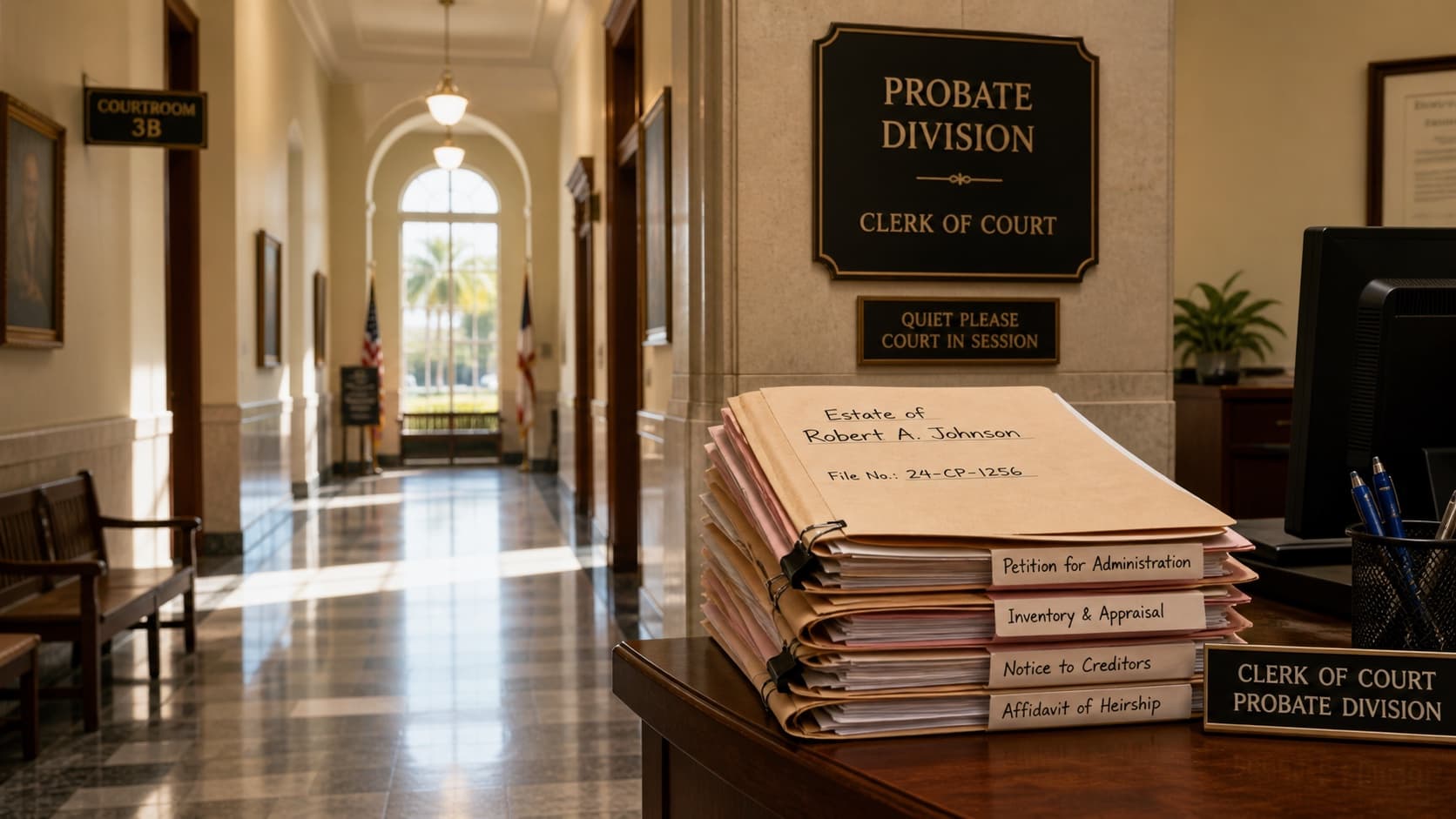
If you invest in Florida real estate, the Florida probate process is one of the most reliable sources of motivated-seller leads in the state. But probate is not one event — it is a sequence of court-supervised stages that play out over months, and the stage an estate is in determines whether investor outreach is welcome or premature.
This guide walks through the Florida probate process step by step, focused on formal administration — the path most estates with real estate follow. It cites the controlling statutes and rules, gives you the timing for each stage, and points out the moments investors typically engage with Florida probate leads.
The Florida Probate Timeline at a Glance
Most contested or moderately complex Florida formal administrations close between 9 and 12 months from filing. Simple, uncontested estates can move faster; estates with disputes, real property in multiple states, or unresolved tax issues take longer.
Here is the high-level shape of the process. Each step is detailed below.
| Step | Timing | Controlling Authority |
|---|---|---|
| 1. Will deposited with clerk | Within 10 days of death | F.S. 732.901 |
| 2. Petition for Administration / Letters issue | Typically 2–4 weeks after filing | F.S. 733.301–305, 733.402 |
| 3. Notice of Administration served | Promptly after appointment; 3-month objection window | F.S. 733.212 |
| 4. Verified inventory filed | Within 60 days of issuance of Letters | Fla. Prob. R. 5.340(a) |
| 5. Notice to Creditors published | Once a week for 2 consecutive weeks | F.S. 733.2121 |
| 6. Creditor claims period | Later of 3 months after first publication or 30 days after service | F.S. 733.702 |
| 7. Final accounting, distribution, discharge | Once claims resolved and assets distributable | F.S. 733.901, 733.903 |
The Four Paths Through Florida Probate
Before the steps, a quick orientation. Florida law actually offers four paths through probate, and which one applies controls the timeline and the cost:
- Formal administration — the standard, court-supervised process. Required for most estates with non-exempt assets above the summary threshold. This is the path covered in detail below.
- Summary administration — a streamlined path for smaller estates. Florida's new $150,000 summary administration threshold takes effect July 1, 2026, doubling the cap from $75,000 and pulling many more estates into the faster lane.
- Ancillary administration — used when an out-of-state decedent owned Florida real property. Layered on top of a primary probate elsewhere.
- Disposition of personal property without administration — for estates with only exempt property and limited reimbursable expenses; not relevant to real estate.
Throughout this article, "probate" refers to formal administration unless noted otherwise.
Step 1: Deposit the Will (10 Days)
Under F.S. 732.901(1), the custodian of the will — usually a family member or the named executor — must deposit it with the clerk of the circuit court in the county of the decedent's domicile within 10 days of learning of the death. Filing the will does not start probate. It is a standalone duty that protects the will from being lost or altered.
For investors, the will-deposit filing is the earliest public signal that an estate exists. It precedes any petition, any personal representative, and any contact information for the estate's representative or attorney. At this stage there is typically no one to talk to about the property.
Step 2: Petition for Administration and Letters of Administration
The estate is opened when an interested person files a Petition for Administration in the circuit court. The petition asks the court to admit the will to probate (if there is one) and to appoint a personal representative — Florida's term for what other states call an executor or administrator.
The court evaluates whether the proposed personal representative is qualified under F.S. 733.302–303. Florida is unusually strict here: the personal representative must generally be a Florida resident (or a close relative, such as a spouse, parent, or child of the decedent), at least 18, mentally and physically capable, and not a convicted felon. F.S. 733.402 requires a bond unless the will waives it or the court determines none is necessary.
Once the court is satisfied, it issues Letters of Administration — a one-page order granting the personal representative legal authority to act for the estate. From the petition to Letters typically takes 2 to 4 weeks, depending on the county and whether the filing is complete.
For investors, this is the first stage where outreach makes sense. Letters identify the personal representative and the estate's attorney by name and address. That information becomes part of the public record on the case docket.
Step 3: Notice of Administration and the 3-Month Objection Window
Under F.S. 733.212, the personal representative must promptly serve a Notice of Administration on the surviving spouse, beneficiaries, heirs, and other interested parties. The notice tells them the estate has been opened and identifies the court, the case number, the personal representative, and the attorney.
The notice also opens a clock: an interested party who wants to challenge the validity of the will, the venue, or the court's jurisdiction generally has 3 months from service to file an objection. Miss that window and those challenges are barred.
This is also the moment when family disputes — disinherited children, contested second marriages, missing wills — surface. A noisy objection period can stretch the entire probate by months or years.
Step 4: Verified Inventory (60 Days)
Florida Probate Rule 5.340(a) requires the personal representative to file a verified inventory within 60 days after Letters issue. The inventory lists each estate asset with reasonable detail and the asset's fair market value as of the date of death. Real property is included, though homestead is identified separately because it is constitutionally protected and generally passes outside probate.
The inventory is confidential under F.S. 733.604(3) — it is not part of the public docket. But the existence of an inventory filing on the docket signals that the personal representative is active and the estate is moving. Beneficiaries and heirs receive copies; investors do not.
Step 5: Notice to Creditors
F.S. 733.2121 requires the personal representative to publish a Notice to Creditors in a newspaper in the county where the estate is administered. The publication runs once a week for two consecutive weeks. The notice tells anyone the decedent owed money to that they need to file a claim with the court — or be barred forever.
The personal representative must also make a "diligent search" for known creditors and serve them directly with a copy of the notice. Common known creditors include mortgage lenders, hospitals, credit-card issuers, and the IRS.
Step 6: The Creditor Claims Period
F.S. 733.702(1) sets the claim deadline. A creditor must file a claim by the later of:
- 3 months after the first publication of the Notice to Creditors, or
- 30 days after the date the creditor was personally served with the notice.
This 3-month-plus window is the single longest stage in a typical Florida probate. Non-exempt assets generally cannot be distributed to beneficiaries while it is open, because the personal representative does not yet know what claims will be filed against the estate. During this period the personal representative pays valid expenses, secures property, files tax returns, and prepares for distribution.
From an investor's perspective, this is the window where motivation tends to crystallize. The heirs know what they are inheriting. They are usually paying carrying costs — taxes, insurance, utilities — on a property that may be hundreds of miles from where they live. Many decide they would rather receive cash than a distant house.
Step 7: Final Accounting, Distribution, and Discharge
Once the claims period closes and valid claims are paid, the personal representative prepares a final accounting under F.S. 733.901 showing every receipt and disbursement. Beneficiaries either consent to the accounting or object. The court resolves any objections, approves distribution, and the personal representative transfers assets according to the will or — if there was no will — according to Florida's intestate succession statutes (F.S. 732.102 and 732.103).
F.S. 733.903 then governs the personal representative's discharge. After the court approves the discharge order, the estate is closed.
By this stage, real estate has typically already been sold or formally transferred. Investor outreach during the discharge stage is generally too late for the underlying property.
Where Investors Fit in This Timeline
Outreach effectiveness is not uniform across the seven steps. Here is a practical framing:
| Stage | Investor Outreach Quality |
|---|---|
| Will deposit only | Premature — no representative to contact |
| Letters issued (Step 2) | Sweet spot. Representative identified, family aware, before disputes harden |
| Inventory filed (Step 4) | Strong. Estate is actively administered. |
| Mid-creditor period (Step 6) | Strong. Carrying costs accumulating, heirs motivated. |
| Post-distribution / discharge (Step 7) | Late. Property is usually already sold or transferred. |
The takeaway: the highest-leverage outreach window opens once Letters of Administration are issued and stays open through the creditor claims period — roughly the first six months of a typical formal administration.
That is the window PocketLeads is built around. Each morning, our platform delivers same-day Florida probate filings from Collier County, Lee County, Sarasota, and Pinellas, with personal representative names, attorney contact details, and parcel data already enriched. We pull from the public clerk-of-court records the same morning new filings appear, so the leads in your dashboard are typically estates that just had Letters issued.
Whether you focus on cash-offer wholesalers or you are one of the realtors working probate niches, the early-window strategy is the same: identify the personal representative, make a respectful contact, and let the heirs come to you when the carrying costs start to bite.
What Probate Costs (Briefly)
Formal administration in Florida is not free. Court filing fees run approximately $400, with small variations by county. Newspaper publication for the Notice to Creditors typically runs $150 to $300. Personal representative attorney fees are statutory and tied to estate size under F.S. 733.6171 — they are negotiable but commonly amount to 2–3% of the gross estate value for typical estates.
Add appraisals, accounting, and the statutorily-required bond (if not waived) and a $400,000 estate easily incurs $15,000 or more in administrative costs. That is a number worth keeping in mind when an heir is weighing "list it and wait" against a cash offer.
Frequently Asked Questions
How long does Florida probate take?
Most Florida formal administrations close within 9 to 12 months. Simple, uncontested estates can finish in 6 months; estates with will contests, multi-state real property, federal estate tax issues, or active litigation routinely take 18 months or longer.
What is the difference between summary administration and formal administration in Florida?
Summary administration is a streamlined process for smaller estates. It does not require a personal representative, an inventory, or a creditor claims period, and it often closes in 4 to 8 weeks. Formal administration is the standard, court-supervised process for larger estates and follows all seven steps above. Effective July 1, 2026, the summary administration threshold doubles from $75,000 to $150,000 in non-exempt probate assets.
How do investors find Florida probate leads?
The most direct sources are circuit court probate dockets, recorded notices to creditors, and obituary cross-reference. Many investors automate the work with platforms that aggregate Florida probate filings from county clerks and deliver them daily. For background on the obituary cross-reference approach specifically, see how to use obituaries for real estate leads.
When is the best time in the probate process to contact heirs?
After Letters of Administration issue (Step 2) and through the creditor claims period (Step 6) — roughly the first six months of formal administration. Outreach before Letters issue is premature; outreach during the discharge stage (Step 7) is generally too late because the property has usually been sold or transferred.
Does the Florida personal representative have to live in Florida?
Generally yes. Under F.S. 733.304, a non-resident can serve only if they are a close relative of the decedent — a spouse, parent, sibling, child, or other lineal kin. Otherwise they are disqualified.
Is the verified inventory public record?
No. Florida Statute 733.604(3) makes the inventory confidential. The fact that an inventory has been filed appears on the docket, but the contents do not.
Get Florida Probate Leads the Day After They're Filed
The probate process gives investors a long, structured window to engage — but only if you find the filings before everyone else does. PocketLeads pulls probate cases from Florida county clerk records and delivers them to your dashboard the same day, with the personal representative, attorney, parcel, and address data already attached. Get Started Free and see today's filings from Collier, Lee, Sarasota, and Pinellas Counties.