
Florida is the most active pre-foreclosure market in the United States right now. In Q1 2026, the state recorded 10,099 foreclosure starts — second only to Texas — and bank repossessions doubled year over year, jumping from 487 in Q1 2025 to 1,014 in Q1 2026. Two of the three worst-hit metros in the entire country, Lakeland and Punta Gorda, are in Florida.
For real estate investors, that volume creates a steady pipeline of homeowners under financial pressure who are still in control of their property — the brief window before a court-ordered sale where a private offer can solve a problem for both sides. This guide covers exactly what triggers pre-foreclosure status under Florida law, when the public-record signal first appears, and how to source those filings before the rest of the market catches up.
Florida Is Ground Zero for Pre-Foreclosure Activity in 2026
Three data points frame the opportunity:
Q1 2026 starts: 10,099 in Florida — second nationally behind Texas (10,617).
Q1 2026 REOs: 1,014 completed foreclosures, a 108% jump from the same quarter a year earlier.
Q1 2026 rate: one foreclosure filing for every 750 housing units in Florida — the third-highest rate in the country, narrowly behind Indiana and South Carolina.
Zooming in to the metro level, the concentration is even sharper. ATTOM ranks Lakeland the worst metro foreclosure rate in the country at one in every 409 housing units, with Punta Gorda — on the Southwest Florida coast — second at one in 416. Both sit inside the same supply-constrained, insurance-strained, post-pandemic-correction band that runs through the rest of the state.
The takeaway for investors: the inventory exists. The question is how to find it before the property hits the courthouse steps.
What "Pre-Foreclosure" Actually Means in Florida
"Pre-foreclosure" is the period between a borrower's default and the final judicial sale of the home. Florida is one of the strict judicial-foreclosure states — under Florida Statute § 702.01, "all mortgages shall be foreclosed in equity," meaning every residential foreclosure is a lawsuit filed in the local circuit court, served on the homeowner, and approved by a judge before any sale can occur.
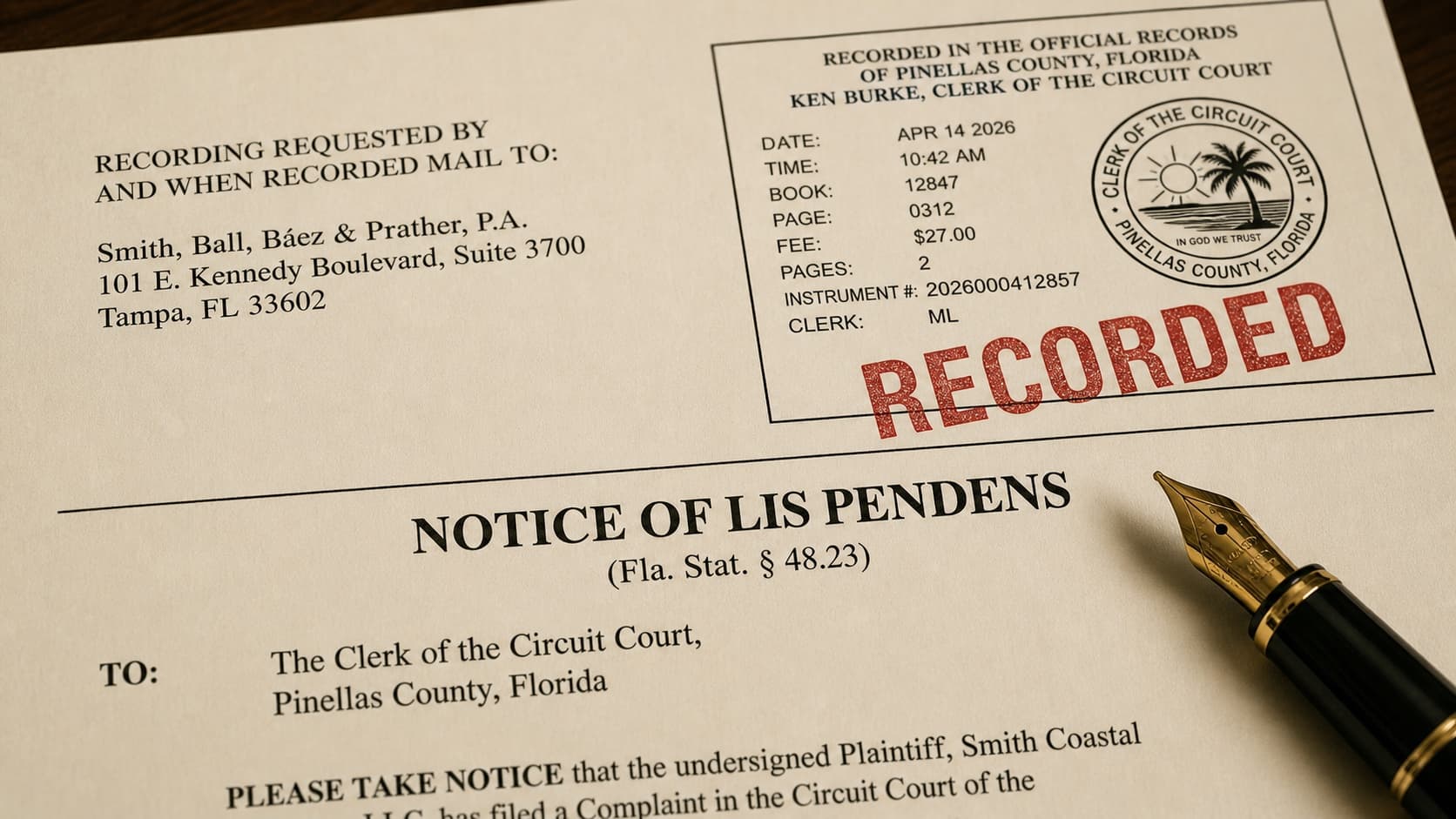
That matters for lead generation because the legal process leaves a trail of public records. The single most actionable record is the Notice of Lis Pendens — Latin for "suit pending" — recorded under Florida Statute § 48.23 in the official records of the county where the property sits.
The lis pendens does two things at once: it tells the world a lawsuit affecting that specific property has been filed, and it freezes the chain of title against any unrecorded interests. Per § 48.23(1)(d), any unrecorded lien holder has just 30 days from the recording of the notice to intervene before they are cut off entirely. The notice itself is effective for one year from the commencement of the action, unless the underlying claim is anchored to a duly recorded instrument such as a mortgage — which, in a foreclosure, it almost always is.
For an investor, the practical translation is simple: the day the lis pendens hits the official records, the property is in pre-foreclosure, the homeowner has been formally placed on notice, and the clock has started.
The Florida Pre-Foreclosure Timeline
The full timeline from first missed payment to courthouse sale moves through six identifiable stages. Knowing where a given file sits in the sequence tells you how much room there is to negotiate.
Stage | Trigger | Approximate Timing |
|---|---|---|
1. Default | Borrower misses a scheduled mortgage payment | Day 0 |
2. Federal pre-suit waiting period | Under 12 CFR § 1024.41(f)(1), a servicer cannot initiate foreclosure unless the loan is more than 120 days delinquent (with narrow exceptions for due-on-sale clauses or joining another lienholder's action) | Day 0 → ~120 |
3. Lis pendens + complaint filed | Lender files a foreclosure complaint in circuit court and records a Notice of Lis Pendens against the property under FL Stat § 48.23. This is the first public-record event; it is the moment the property officially becomes "pre-foreclosure." | ~Day 120–150 |
4. Service + 20-day answer window | Borrower is formally served and has 20 days to file an answer to the complaint | ~Day 150–170 |
5. Final judgment of foreclosure | If unanswered or undefended, the court can enter judgment under the expedited procedure in FL Stat § 702.10. The judgment sets the sale date and the redemption deadline. | Varies — weeks to months after answer window closes |
6. Judicial sale + certificate of sale | Property is sold at public auction. Once the clerk files the certificate of sale, the homeowner's right of redemption under FL Stat § 45.0315 is extinguished — "otherwise, there is no right of redemption." | Set in the final judgment |
For an uncontested filing, the entire sequence typically runs about 8 to 14 months from first missed payment to sale. Contested cases can run 14 to 24 months. The lis pendens is recorded near the front of that window, not the end — which is what makes it the highest-leverage signal for an investor who wants real time to underwrite, contact, and close.
Why Lis Pendens Is the Highest-Value Pre-Foreclosure Signal
Several types of records can hint that a property is in distress: tax delinquency lists, code-enforcement liens, even Notice of Default filings in the few states that allow them. In Florida, none of those carry the same weight as a recorded lis pendens, for four specific reasons.
It's a public record by design. FL Stat § 48.23 specifies that the lawsuit operates as a lis pendens "only if a notice of lis pendens is recorded in the official records of the county where the property is located." Recording is the entire point. Investors with access to county records (or a platform that aggregates them) can see every new filing.
It attaches directly to the title. The notice is indexed against the parcel itself, which means the property is now flagged for any future buyer, lender, or title company. The homeowner cannot quietly refinance or sell out of the situation.
It has a known shelf life. Per § 48.23(2), a notice is not effective beyond one year unless tied to a duly recorded instrument (which, in a mortgage foreclosure, it always is). Filings older than a few months are still in play but increasingly close to a sale event.
It marks the start of the legal clock — not the end. Because the lis pendens is recorded near the beginning of the lawsuit, an investor who acts on a fresh filing usually has months of runway before the certificate of sale closes the redemption window under § 45.0315.
Tax-delinquency lists, by comparison, identify financial pressure without committing the homeowner to any specific timeline. Code-enforcement liens flag deferred maintenance but rarely lead to a forced sale. Lis pendens is the only Florida-specific record that tells you, to the day, that a judicial process is now running against a particular parcel.
Where Investors Source Pre-Foreclosure Leads in Florida
Once you know the lis pendens is the signal, the question becomes: how do you find them, fast, every day, without spending the morning logging into 67 different county systems?
Source | How It Works | Trade-offs |
|---|---|---|
County clerk's official records | Each Florida county clerk publishes a public official-records search. Filings are indexed by document type — search "lis pendens" or "LP" by date. | Free and authoritative. But you check 67 different sites with 67 different interfaces, no parcel match, no contact info, no enrichment. Workable for one county; impractical at portfolio scale. |
National foreclosure-list aggregators | Vendors compile foreclosure filings nationwide and sell access by subscription, often as weekly CSV exports. | Wide coverage. But the cadence is typically weekly, the data is often a few days old by the time it ships, and the records are rarely matched to skip-traced contact information for the actual homeowner. |
Wholesale list brokers | One-time purchases of "distressed" or "absentee" lists, sometimes blended with pre-foreclosure indicators. | Cheap up front. But mixed criteria mean only a fraction are actually pre-foreclosure, the data ages quickly, and there's no daily refresh. |
PocketLeads | Pulls foreclosure filings directly from the courts in Collier, Lee, Sarasota, and Pinellas counties every day. Each filing arrives matched to the parcel, linked to the assessed and estimated market value, and skip-traced to homeowner contacts. | Florida-only, four active counties (with more coming). The trade is depth and speed over breadth. |
Get Florida Pre-Foreclosure Filings the Day After They Hit the Court
PocketLeads pulls foreclosure filings directly from the county courts every business day — Collier, Lee, Sarasota, and Pinellas, with more counties on the way. When a lis pendens is recorded, it lands on your dashboard the same day, with the parcel match, owner of record, estimated equity, and skip-traced contact information already attached.
No spreadsheets to clean. No weekly CSV from a national vendor. Court-verified, same-day, action-ready.
How to Approach Pre-Foreclosure Homeowners Without Breaking the Relationship
The fastest way to lose a pre-foreclosure deal is to treat the homeowner like a target. People who have just been served with a foreclosure complaint are usually scared, embarrassed, and exhausted — not in a state to receive an aggressive pitch. Three principles consistently hold up:
Lead with information, not pressure. The homeowner often does not understand their own timeline. A short, direct explanation of what the lis pendens means, how long they likely have before sale, and what their realistic options are (loan modification, short sale, private sale, redemption) earns more conversations than any "we buy houses" angle.
Don't impersonate the lender or the court. Federal and state consumer protection rules treat any communication that looks like an official notice as a violation. Use your own name and company, identify yourself as an investor, and keep the conversation transparent.
Match the channel to the moment. A first-touch letter that arrives a week after the lis pendens is recorded sets up an inbound call far more reliably than a cold-call the day after service. Direct mail and follow-up voicemail tend to outperform aggressive door-knocking, especially in the early weeks of the case.
The investors who consistently close pre-foreclosure deals in Florida are not the ones who reach the homeowner first by hours. They are the ones who reach the homeowner first with something useful to say. The data freshness only matters if the outreach behind it is worth opening.
Frequently Asked Questions
What is a lis pendens in Florida?
A lis pendens — Latin for "suit pending" — is a notice recorded in the official records of a Florida county under Florida Statute § 48.23 that announces a lawsuit affecting a specific piece of real property. In a residential foreclosure, the lender records the lis pendens against the property at the time the foreclosure complaint is filed in circuit court. The notice puts any future buyer, lender, or title company on constructive notice that the property's title is subject to the outcome of the lawsuit.
When does pre-foreclosure officially start in Florida?
For practical purposes, pre-foreclosure begins when the Notice of Lis Pendens is recorded — typically around day 120 to 150 after first default. Federal mortgage servicing rules under 12 CFR § 1024.41(f)(1) prohibit servicers from initiating foreclosure unless the loan is more than 120 days delinquent (with narrow exceptions for due-on-sale violations and joining another lienholder's action), so the lis pendens almost never appears before that mark.
Can a homeowner stop foreclosure after a lis pendens is filed?
Yes — Florida Statute § 45.0315 gives the homeowner the right to redeem the mortgage and stop the sale at any time before the later of the clerk filing the certificate of sale or the deadline specified in the foreclosure judgment. To redeem, the homeowner must pay the full judgment amount plus the reasonable costs and attorney's fees of the proceeding. After that cutoff, the statute states that "there is no right of redemption."
How long does the Florida foreclosure process take?
An uncontested judicial foreclosure in Florida typically runs about 8 to 14 months from first missed payment to courthouse sale. Contested cases — where the borrower mounts a defense, raises lender-standing issues, or applies for loss mitigation — can run 14 to 24 months. Florida is exclusively a judicial-foreclosure state, so every case must go through the circuit court.
Are pre-foreclosure leads public records in Florida?
Yes. Florida Statute § 48.23 specifies that a lawsuit operates as a lis pendens "only if a notice of lis pendens is recorded in the official records of the county where the property is located." That means every active pre-foreclosure case generates a public-record filing that any investor — or any aggregation platform — can locate by parcel.
What's the difference between pre-foreclosure and foreclosure?
Pre-foreclosure is the window between the lender filing the lawsuit (and recording the lis pendens) and the judicial sale of the property. The homeowner still owns the property, can still negotiate with the lender, and can still sell privately. Foreclosure, in the strict sense, is complete when the property is sold at the judicial auction and the clerk files the certificate of sale — at which point title passes to the highest bidder and the homeowner's redemption right is extinguished under FL Stat § 45.0315.