

If you're new to Florida real estate investing and someone tells you to "work obituary leads," your gut probably tightens. It sounds opportunistic — mailing letters to grieving families? Cold-calling about Mom's house? There's a right way and a wrong way to do this, and most beginners get taught the wrong way.
Done well, obituary leads are one of the highest-converting lead sources in real estate. Vendor data from platforms like ProbateData and AllTheLeads puts probate conversion rates in the 8–40% range depending on how well the lead is qualified, compared to 1–5% for traditional seller leads. Industry vendor data suggests profit margins can run 15–25% higher per deal, and because probate remains a specialized niche that most agents don't work, the competition is thinner than in conventional lead channels.
Done poorly, you'll get called a vulture, torch your reputation, and burn through a year of mail budget learning what to avoid.
This guide is the ethical, Florida-specific playbook we wish every beginner had before their first mailer. You'll learn how the obituary-to-lead pipeline really works, the exact Florida probate statutes you need to know, the timing window that actually converts, and the seven mistakes that kill deals before they start.
An Obituary Is Not a Lead
This is the single most important thing to understand before you spend a dollar on postage:
An obituary is a signal. A lead is an obituary cross-referenced with Florida property records, a paid-off home, and the right heir to contact.
Chasing raw obituaries is how beginners waste money. A decedent may have been a renter, lived in assisted living, or owned a home in another state. Until you confirm Florida ownership and identify who actually controls the sale, you have nothing. The real work — and the real edge — is in the cross-reference.
Here's the pro workflow every successful Florida probate investor follows:
Obituary — decedent's full name, age, city, surviving relatives, hometown.
County property appraiser — confirm decedent owned Florida property, pull parcel ID, market value, homestead status, and any mortgages.
Clerk of Circuit Court (probate division) — check for an open probate case, identify the personal representative (PR) and estate attorney. No case yet? Even better — that's pre-probate.
Skip trace — phone and mailing address for the PR, especially if they live out of state.
Equity screen — prioritize free-and-clear or low-LTV properties. Probate's edge is paid-off Florida homes owned by elderly decedents.
Homestead flag — if the decedent had a homestead exemption, the property passes outside probate to the spouse or descendants. Your outreach strategy changes completely.
Every step matters. Skip one and you're mailing the wrong person, at the wrong time, about a property the estate doesn't control.
Where Obituary Data Comes From
Obituaries are public information. In Florida, the primary sources are aggregator sites like Legacy.com (which pulls from nearly every major Florida newspaper and funeral home), the state's major dailies — Tampa Bay Times, Orlando Sentinel, Miami Herald, Sun Sentinel, Naples Daily News, News-Press — and individual funeral home websites, which often publish obituaries days before the aggregators pick them up.
Why Manual Sourcing Breaks at Scale
The theory of working obituaries yourself sounds simple. The reality breaks the moment you try to operate at any meaningful scale:
67 Florida counties, publishing daily. Hundreds of new obituaries appear every day across the state. Reading them all is a full-time job by itself — before you've cross-referenced a single one.
Each county appraiser portal is different. Collier, Lee, Pinellas, Broward, Hillsborough — they all have separate websites, different search interfaces, and inconsistent data quality. Every verification is a manual, click-heavy process.
Probate court filings are siloed. The Clerk of Circuit Court's probate division is a separate system in every county. No unified search.
Skip tracing costs add up. Running contact lookups on every obituary-matched property burns budget fast when most won't convert to leads.
Homestead and equity screening is math-heavy. Pulling mortgage records, calculating equity, and flagging homestead exemptions per parcel is tedious at volume.
The math is unforgiving at any real scale. A platform running automated data collection, AI document extraction, and parallel skip tracing can cover the whole state in the time it takes a solo investor to qualify a single county by hand.
This is exactly the gap PocketLeads was built to close. Every Florida obituary, automatically matched against county property appraiser records, probate court filings, equity calculations, and skip-traced contacts — delivered the morning after the filing, ready to work. You spend your time on outreach, not data entry.
Florida Probate Basics Every Beginner Must Know
Before you mail a single letter, you need to understand the Florida rules. Getting this wrong is how beginners end up talking to the wrong heir about a property the estate can't sell.
Statute | What It Means |
|---|---|
Fla. Stat. §732.901 | The custodian of the will must deposit it with the Circuit Court clerk within 10 days of learning of death. This is not a deadline to open probate — probate petitions often aren't filed for weeks or months. |
Fla. Stat. §733.613 | If the will grants a specific or general power of sale, the personal representative can sell real property without court confirmation. Buyers take clean title. |
Fla. Stat. §732.401 | A surviving spouse has 6 months from death to elect a ½ interest in the homestead (vs. the default life estate). Many elect to sell and split — a critical timing window. |
Fla. Stat. §733.710 | Creditor nonclaim statute: 2 years post-death. This is the practical outer limit for probate leads retaining selling urgency. |
Fla. Stat. §733.610 | Any sale from the estate to the PR (or their spouse, agent, attorney, or affiliated entities) is voidable without disclosure and consent or court approval. This is a self-dealing rule that binds the PR — it doesn't block arms-length investors, but don't become the PR's "agent" by accepting fees or favors. |
Summary vs. Formal Administration
Florida offers two probate tracks. Summary administration is faster and cheaper — it applies if non-exempt assets are under $75,000 or if the decedent died more than 2 years ago. Formal administration is the standard track for larger estates.
Here's the beginner secret: homestead is excluded from the $75K cap. A paid-off $500,000 Florida home owned by an elderly decedent can absolutely qualify for summary administration, which means faster sales and faster conversion for well-timed outreach.
The Homestead Twist
Florida homestead gets special legal treatment, but it doesn't skip probate entirely. Under the Florida Constitution and Fla. Stat. §732.401, homestead is not an estate asset for creditor claims — the PR can't sell it to pay the decedent's debts — and it descends under special rules (surviving spouse gets a life estate by default, or a ½ fee simple interest if elected within 6 months). In practice, a probate proceeding is still usually required to clear title — typically a "Petition to Determine Homestead Status."
For lead targeting, this matters: some inherited Florida homes — especially elderly widows in paid-off properties — track through this quieter, faster process rather than standard formal administration, which is why obituary + property appraiser cross-referencing finds them earlier and more reliably than watching probate court filings alone.
The Ethical Timing Window (Why Fresh Obits Are Worse)
The conventional wisdom says "be first." With probate, the conventional wisdom is wrong.
Industry consensus from experienced probate investors — Sharon Vornholt, PropertyRadar, AllTheLeads — is that the initial contact window is 4 to 8 weeks post-death, not the day after. Here's why:
Weeks 0–4 — research only. The family is arranging funerals, notifying relatives, dealing with immediate grief. Any contact here is where you earn the "vulture" label.
Weeks 4–8 — first empathetic, permission-based contact. Plain envelope, respectful letter, no pitch.
Months 2–3 — informational follow-up. Offer a probate resource packet, not an offer.
Months 3–6 — direct options conversation. Now the family is past the emotional acute phase and starting to think about logistics.
6+ months — periodic check-ins. This is where most deals actually close.
Here's the contrarian data point most beginners miss: older probate leads often convert better than fresh ones. AllTheLeads and experienced probate wholesalers document this plainly — 6+ month old leads face less competition, the heirs are emotionally ready, and pricing is more flexible. Most probate families don't have financial urgency in the first 30 days. The long-tail prospects reward patience.
Our recommendation for beginners: adopt a self-imposed 30-day quiet period. The Florida Bar imposes a 30-day direct-mail solicitation ban on personal injury attorneys after an accident — upheld by the U.S. Supreme Court in Florida Bar v. Went For It, Inc., 515 U.S. 618 (1995) — on the reasoning that unsolicited outreach during grief invades privacy and erodes professional reputation. The rule doesn't apply to real estate professionals, but voluntarily adopting it is both ethical and practical. You avoid the hostile-response window, and you lose almost nothing, because the sellers you want weren't going to transact in month one anyway.
Who to Contact (and Who Never to Contact)
Not all heirs respond the same. Probate investing veterans consistently report:
Best response rate — out-of-state adult children, especially when serving as personal representative. They want the property sold, they can't easily manage it from a distance, and they're typically the most rational decision-makers.
Worst response rate — surviving spouses and surviving parents of the decedent. These are the highest-hostility segments — the grief is rawest, and any outreach reads as predatory regardless of how respectful your language.
Beginners mail everyone. Pros filter. Exclude surviving spouses and parents of the decedent from your mail list. Target adult children — out-of-state ones first.
The Outreach Playbook
If you remember nothing else from this section, remember Sharon Vornholt's rule: "Your goal has to be to solve their problem and create a bridge from where they are today to where they want to go." You're not in the house business — you're in the problem-solving business.
Direct Mail: Letters Beat Postcards
Use plain white envelopes — no company branding, no color. The mail carrier shouldn't be able to tell it's a real estate solicitation.
Typed letters, not postcards. Vornholt explicitly recommends personalized white computer-generated letters over yellow letters or postcards for probate. Postcards expose the recipient to unwanted public attention on their mail route.
Mail 5+ times. Most probate deals close on the 5th mailing or later. Most investors quit after 3. If your budget only covers 3 mailings, mail fewer prospects and commit to the full sequence.
Letter structure — name the pain, offer a clear solution, include a specific call to action (a free probate resource, a no-obligation consultation), repeat the CTA.
Phone: Permission First, Pitch Never
Cold-calling probate leads works — if the first call has zero pitch. A permission-based opener that's widely used in the industry:
"Hi, my name is [X]. I run a company locally called [Y]. Listen, I don't want to take a bunch of your time. This is about the estate of [Deceased]. It looked like you might be the personal representative — is that right?"
The goal of call one is not to list a property. It's to confirm the PR's identity and earn permission to send a free probate resource packet. Everything else is built on that foundation.
And before you pick up the phone: scrub every number against the Florida state DNC list and the federal DNC registry. Federal TCPA violations carry $500–$1,500 per call in statutory damages, and Florida's own mini-TCPA (the Florida Telephone Solicitation Act) imposes similar penalties for automated calls and texts. Keep calls between 8 AM and 9 PM local time. Rescrub lists every 31 days.
What NOT to Do: Seven Mistakes That Kill Deals
Don't mail within 30 days of death. The single biggest reputation killer. The hostile responses are loud, and they end up on Google.
Don't send postcards with the decedent's name visible. Plain white envelope, typed letter, no branding on the exterior.
Don't skip ownership verification. Many decedents were renters or in care facilities. Cross-check every obit against the county property appraiser before spending a stamp.
Don't target surviving spouses or parents. Highest hostility, lowest conversion. Filter them out.
Don't claim to be a court official, attorney, or county employee. That's fraud, not marketing.
Don't pitch on call one. Goal = confirm PR + earn permission. Pitching on call one is what makes probate outreach feel predatory.
Don't structure below-market deals or get entangled with the PR. The real trap for investors isn't buying from an estate — it's buying at a price heirs can later challenge as below fair market value, which is a breach of the PR's fiduciary duty to the estate. Document fair market value, keep the transaction arms-length, and never pay the PR personal fees or kickbacks. Fla. Stat. §733.610 voids sales where the PR has a conflict of interest — including through agents — so don't let the PR become your "inside person."
ROI Benchmarks: What to Expect
Metric | Probate / Obituary Leads | Traditional Leads |
|---|---|---|
Conversion rate (vendor-reported) | 8–40% (by qualification) | 1–5% |
Profit margin uplift | +15–25% | Baseline |
Typical sales cycle | 3–12 months | 1–3 months |
Mailings to typical close | 5+ touches | Varies |
Competition level | Specialized niche (most agents don't work it) | Crowded |
Note that the 40% top end comes from probate lead vendor data and represents highly qualified leads — real-world performance varies with outreach quality and targeting. Set realistic expectations: your first deal from obituary leads probably won't close inside 90 days. Budget for 6+ months of consistent, multi-touch outreach before you see real conversions. The math works — it just doesn't work fast.
How PocketLeads Does This For You
Everything we've just described — obituary sourcing, property appraiser cross-referencing, probate court checks, skip tracing, equity screening, homestead flagging — is what PocketLeads does automatically, for every Florida county we cover.
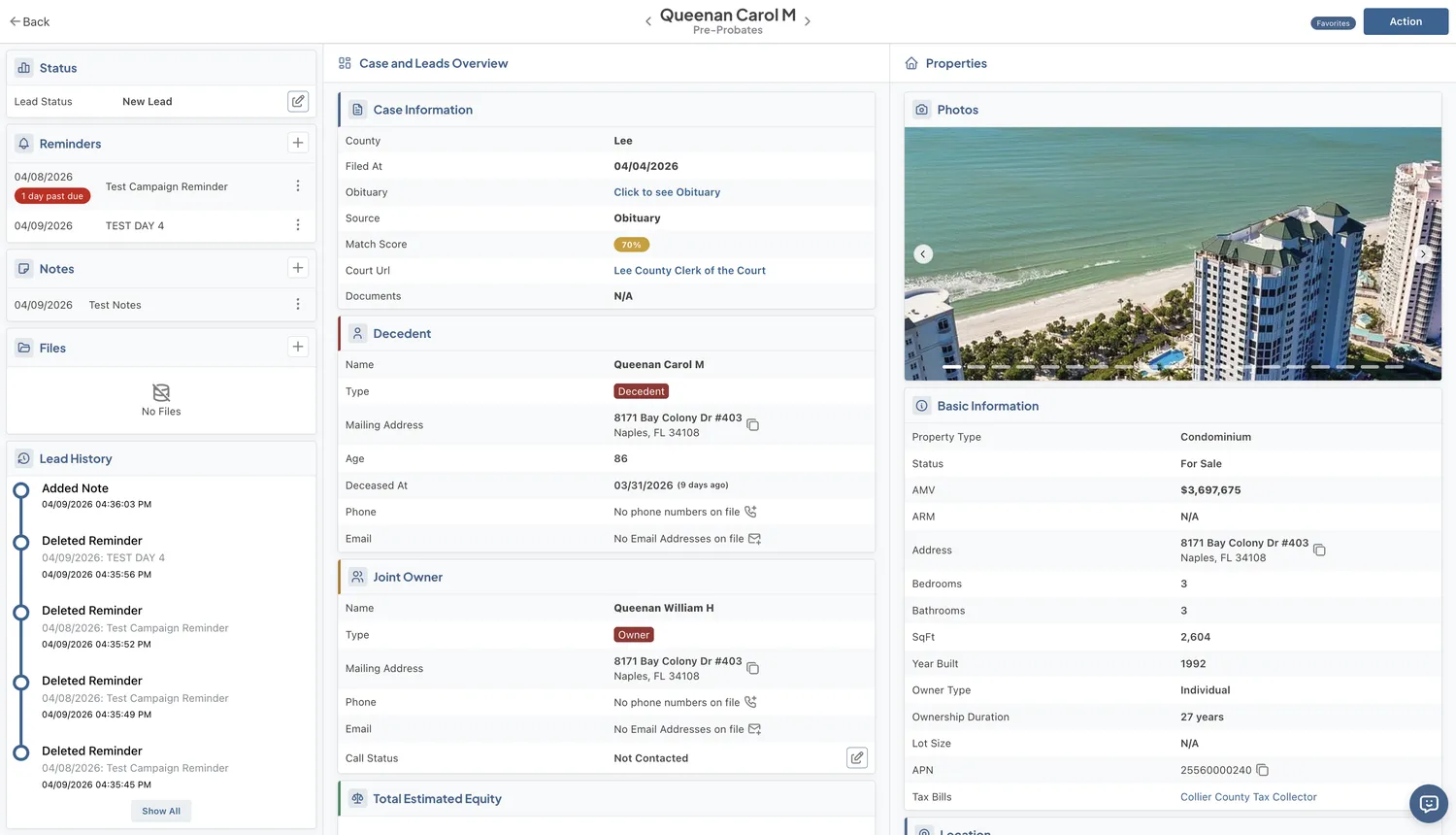
Instead of spending an hour per obituary verifying ownership, pulling court records, and skip-tracing the PR, you get an enriched lead profile the morning after the filing — with the personal representative identified, property valued, equity calculated, homestead flagged, and contact information ready.
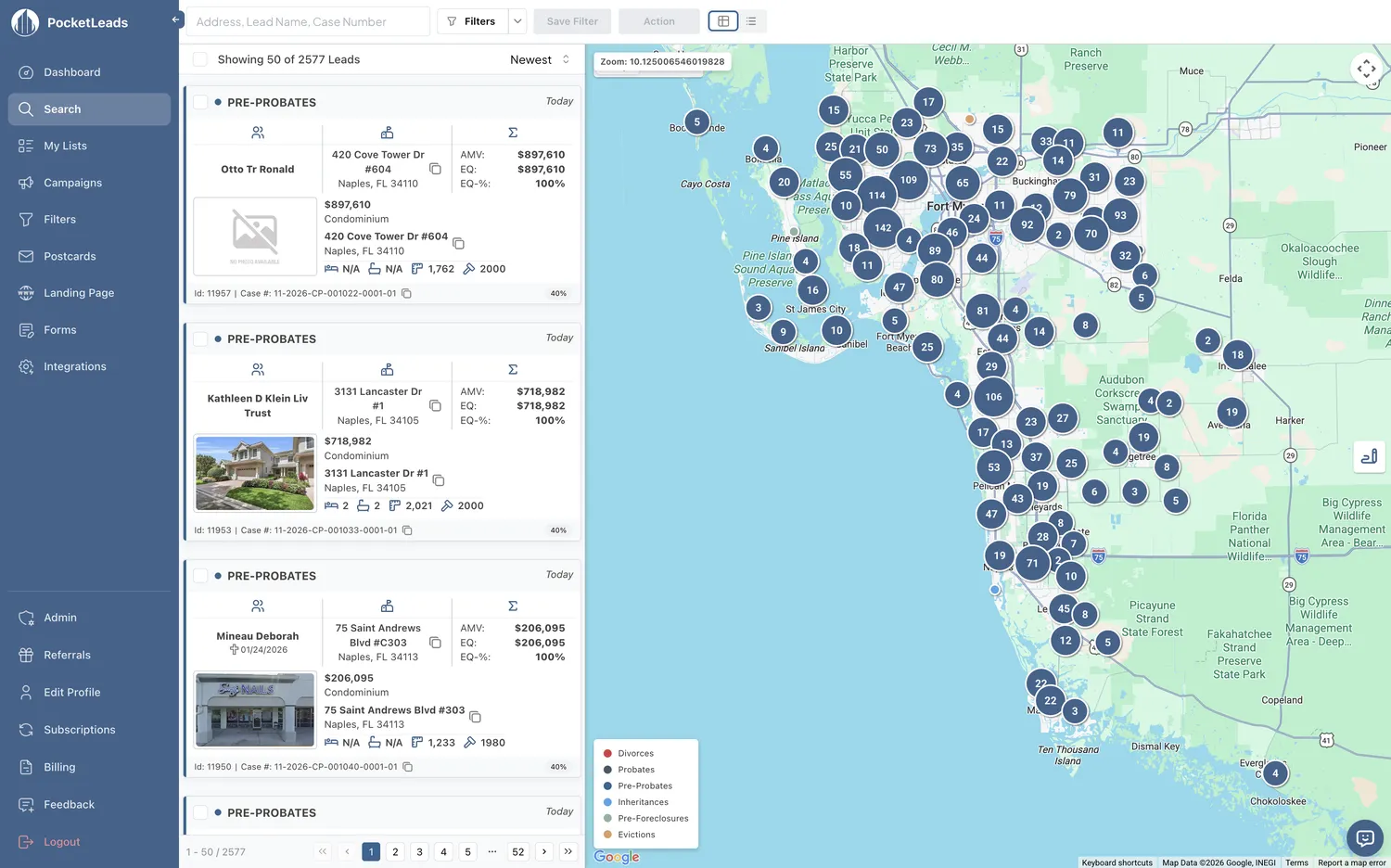
The search and filter layer does the hard part: filter by equity range, exclude surviving spouses, prioritize out-of-state PRs, cluster by county. Send a targeted mailer to the right subset, not the whole list — and spend your time on the outreach instead of the data work.
Work Florida Probate Leads the Right Way
Start free — no credit card — and get same-day Florida probate and inherited property leads — cross-referenced, skip-traced, and ready to work ethically.