
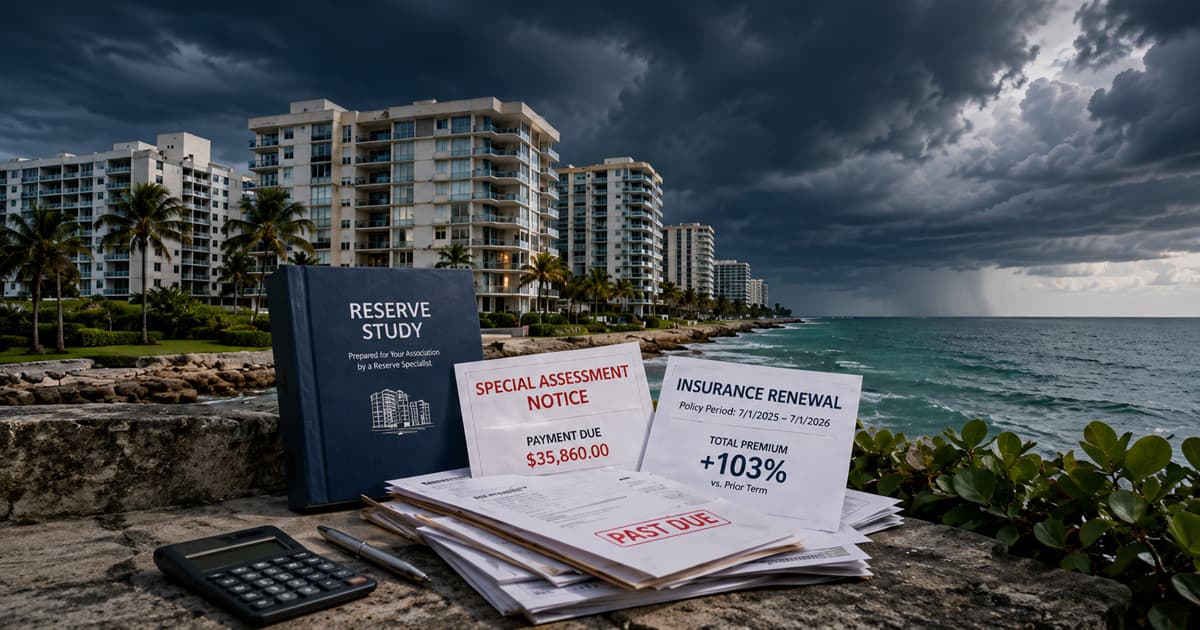
Florida condo foreclosures are at the center of a story the national numbers only hint at. In May 2026, Florida posted the worst foreclosure rate of any state — one filing for every 2,110 housing units, about 1.7 times the national rate of one in 3,562, according to ATTOM's May 2026 report. The headline is foreclosures. The subtext, in thousands of older coastal buildings, is a reserve bill that finally came due. Here is what is actually happening, what the law now requires, and what it means for investors working Florida's distressed market.
Florida leads the nation's foreclosure numbers
The Florida foreclosure rate in 2026 is not a rounding-error lead. ATTOM's May 2026 data puts Florida first among all states at one foreclosure filing for every 2,110 housing units — ahead of South Carolina (one in 2,287) and Maryland (one in 2,369). Florida also recorded the second-highest number of foreclosure starts of any state that month, 3,315, trailing only Texas (3,590).
The pressure is concentrated in Florida's largest metros. Tampa ranked third nationally for foreclosure rate among major metro areas (one in 1,878), and Orlando ranked fifth (one in 2,034). Nationally, 40,355 properties had a foreclosure filing in May 2026 — down 5% from April but up 14% from a year earlier, with starts up 13% year over year.
One caveat matters before anyone draws a straight line: ATTOM's report does not break filings down by property type, and it does not attribute Florida's rate to any single cause. But the timing lines up with a financial deadline that has been bearing down on Florida's condo market for four years.
The reserve cliff, explained
The "Florida condo reserve cliff" traces back to a tragedy. On June 24, 2021, the Champlain Towers South condominium in Surfside partially collapsed, killing 98 people. In the aftermath, the Florida Legislature passed Senate Bill 4-D in May 2022 — the Florida Condo Safety Act — to make sure aging buildings could no longer defer the structural work that goes unfunded until it becomes catastrophic.
SB 4-D layered two requirements onto condominiums three or more habitable stories tall: a milestone structural inspection (first required when a building turns 30, or 25 in coastal zones, then every 10 years), and a Structural Integrity Reserve Study (SIRS), due by December 31, 2025, that prices out the long-term cost of maintaining a building's critical components.
The part that bites is the funding rule. For decades, many Florida associations voted to waive or underfund reserves to keep monthly dues low. As of January 1, 2025, associations of buildings three or more habitable stories can no longer do that — they must fully fund reserves based on their SIRS. And as of January 1, 2026, the grace period on the new safety laws ended. Years of deferred maintenance, in other words, came due all at once.
What "fully funded reserves" actually costs
The bill arrives in two forms. The first is the special assessment. Across older coastal buildings, Florida condo special assessments are running anywhere from $10,000 to more than $100,000 per unit to catch reserves up to where the law now requires them. For an owner on a fixed income in a 1980s beachfront mid-rise, that is not a line item — it is a decision about whether to keep the home.
The second is insurance. Even structurally sound buildings have been hit hard. Florida condo association master policies averaged $72,570 in mid-2022 and $147,381 by mid-2024 — a 103% increase across the 13,841 associations in the Florida Office of Insurance Regulation's data, as reported by the South Florida Sun Sentinel. Flood premiums under FEMA's Risk Rating 2.0 have continued climbing by as much as 18% a year. Those costs land on owners as higher dues and mid-year assessments.
Stack the assessment on top of the insurance, and a meaningful share of owners in older condos are being priced out of buildings they own outright. That is the documented pressure sitting underneath the foreclosure numbers — not a proven cause, but a force pushing in the same direction at the same time.
HB 913: the relief valve most coverage misses
Here is the wrinkle most headlines skip. In 2025, Florida did not double down on the cliff — it built a relief valve. HB 913, signed by Governor DeSantis in June 2025 and effective July 1, 2025, gave associations more ways to absorb the cost without forcing an immediate cash call.
Under HB 913, an association required to obtain a SIRS may now fund reserves and repairs through loans, lines of credit, or special assessments, provided a majority of all unit owners authorize it — spreading a six-figure repair over years instead of one brutal invoice. Boards must also hold a membership vote before adopting a budget that jumps more than 15% over the prior year. The 2025 amendments further let associations suspend reserve funding for up to two years after a milestone inspection to redirect money toward urgent repairs, and they raised the reserve-study component threshold from $10,000 to $25,000, narrowing what has to be reserved for.
None of that erases the bill. It changes who can absorb it. A well-governed association with engaged owners can now phase the cost. A chronically underfunded building that deferred for decades, with absentee owners and no appetite to vote in a loan, cannot — and that is exactly where forced sales cluster.
What it means for investors
For investors, the takeaway is precision, not panic. The distress is real, but it is concentrated and identifiable: older, three-plus-story, coastal condo buildings with thin reserves and owners who cannot or will not absorb the assessment. HB 913 is the reason a blanket "Florida condos are crashing" thesis is wrong — the relief valve keeps many assessments from ever becoming foreclosures. The opportunity is in the buildings where it does not.
And the signal shows up early. By the time a distressed condo reaches the courthouse steps, it is the most-competed, least-informative moment in the whole timeline. The owner staring down a $60,000 assessment is most reachable weeks earlier — when the case first appears as a lis pendens, long before an auction date is set. That is the window. Investors who work Florida pre-foreclosure leads at the filing stage reach distressed condo sellers while there is still room to negotiate; the courthouse-steps crowd reaches them when there is not. (If the term is new, our explainer on what a Florida lis pendens means walks through the filing that starts the clock.)
Geographically, the exposure tracks Florida's older condo stock: the Gulf-coast mid-rises of Southwest Florida — Collier County and Lee County — and the dense condo markets around Tampa Bay, including Pinellas County. These are the markets where reserve-cliff economics and the highest metro foreclosure rates overlap.
How to work the condo-cliff window
Three moves separate operators who profit from this from those who just read about it. First, work the early filing, not the auction — a pre-foreclosure record gives you weeks of lead time a public auction never will. Second, underwrite the building, not just the unit: pull the association's reserve and assessment posture, because an unfunded $80,000-per-door repair is a number that belongs in your offer. Third, model the relief valve — if the association has voted in a loan under HB 913, the pressure on that seller is lower than the listing suggests; if it has not, it is higher. Fix-and-flip investors and wholesalers who price the assessment into the deal will out-compete the ones who learn about it at closing.
The condo cliff is not a one-time event — it is a multi-year repricing of Florida's aging towers, and the foreclosure numbers are still climbing year over year. The investors who win it will be the ones watching the right filings in the right counties, the morning they post.
Frequently asked questions
Are condos really driving Florida's foreclosure numbers?
The honest answer is that the public foreclosure data does not say so directly. ATTOM reports Florida's nation-leading foreclosure rate but does not break filings down by property type or assign a cause. What is documented is that Florida's condo owners face an unusual, time-aligned squeeze — the reserve cliff, special assessments, and insurance spikes — that has arrived at the same moment the foreclosure numbers climbed. Treat it as strongly correlated pressure, not proven causation.
What is the Florida condo reserve cliff?
It is the point at which condominium associations three or more habitable stories tall must fully fund their structural reserves and can no longer vote to waive them. Triggered by SB 4-D (2022) after the Surfside collapse, the full-funding requirement took effect January 1, 2025, and the grace period on the new safety laws ended January 1, 2026 — forcing buildings that deferred maintenance for years to catch up at once, often through large special assessments.
What did HB 913 change in 2025?
HB 913, effective July 1, 2025, gave associations financial flexibility the original law lacked. With a majority vote of all unit owners, associations may now fund reserves and repairs through loans, lines of credit, or phased special assessments rather than a single cash call. The law also requires a membership vote before adopting a budget that rises more than 15% year over year, allows a temporary reserve-funding pause after a milestone inspection, and raised the reserve-study component threshold from $10,000 to $25,000.
How big are Florida condo special assessments?
In older coastal buildings, special assessments to bring reserves into compliance have ranged from roughly $10,000 to more than $100,000 per unit. On top of that, soaring association insurance — master policies rose 103% between mid-2022 and mid-2024 in state regulator data — drives higher dues and additional mid-year assessments.
Where are Florida condo foreclosures concentrated?
The pressure tracks older, three-plus-story coastal condo stock and Florida's largest metros. Tampa and Orlando posted among the highest metro foreclosure rates in the nation in May 2026, and Southwest Florida's Gulf-coast condo markets — Collier and Lee counties — carry heavy exposure to reserve-cliff economics. These are the markets where aging buildings and high foreclosure rates overlap.
Work Florida's distressed market at the source
PocketLeads surfaces Florida pre-foreclosure, probate, divorce, and eviction filings from county court records the morning after they post — across four active Florida counties (Collier, Lee, Sarasota, and Pinellas) and expanding. When a condo owner's distress becomes a public filing, you see it while there is still time to make an offer. Get Started Free and put the condo-cliff window to work.