
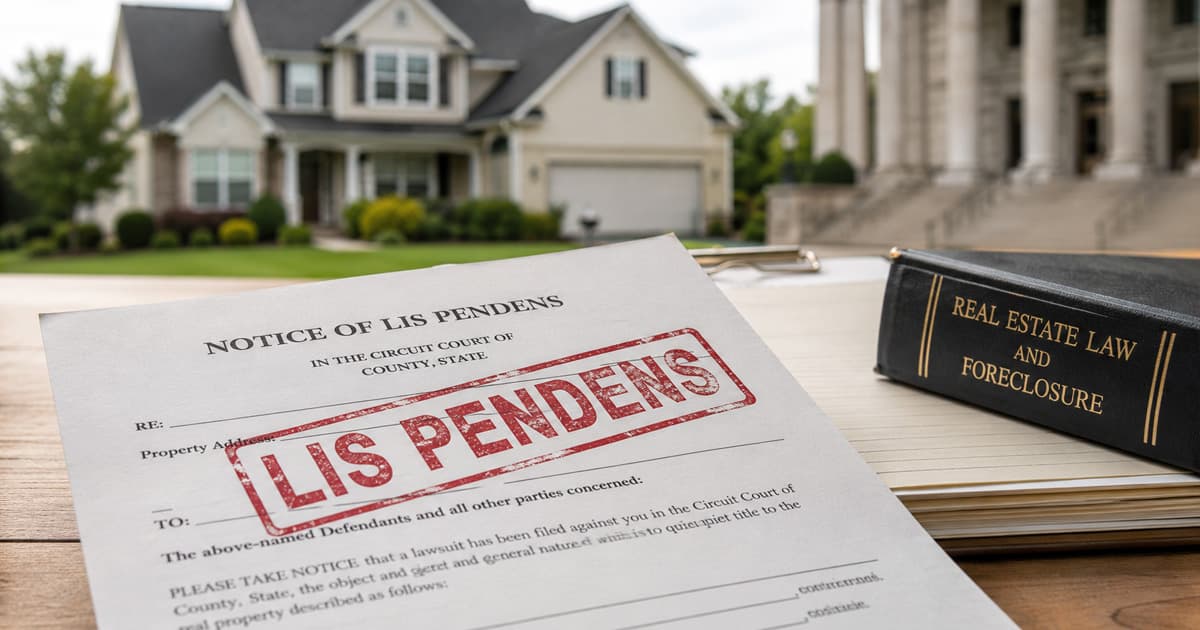
A Florida lis pendens is one of the most actionable signals in real estate — and one of the most misunderstood. Recorded in the county where a property sits, a lis pendens is a public notice that a lawsuit pending in court could change who owns the property. For investors, it is usually the earliest moment a deal becomes visible: weeks or months before a foreclosure auction, often before the property ever hits a multiple-listing service. This guide walks through what a Florida lis pendens is, the statutory rules that govern it under F.S. 48.23, where it fits in the state's judicial-foreclosure timeline, and how investors can use lis pendens filings to find motivated sellers without running afoul of the rules.
What a Florida lis pendens is (and is not)
The phrase lis pendens is Latin for "suit pending." In Florida, it is a written notice — usually a one-page document — recorded in the county Clerk of Court's official records that publicly warns the world: there is a lawsuit involving this property, and anyone who buys, refinances, or takes a lien against it now does so subject to whatever the court eventually decides. It does not transfer ownership. It does not impose a lien. What it does is make the property functionally untradeable until the underlying case is resolved.
That distinction matters. A lis pendens is not the same as a foreclosure judgment, a writ of execution, or a sale. It is the start of a case, not the end. Most Florida lis pendens filings are recorded by mortgage lenders opening a foreclosure case, but they also show up in partition suits between co-owners, quiet-title actions, contested probates, divorce cases where one spouse is trying to lock down the marital home, and construction-lien enforcement. Every one of them clouds title the same way; the underlying motivation varies.
Florida Statute 48.23: the Florida lis pendens rules in plain English
The Florida lis pendens rules live in F.S. 48.23. The statute is short — under a thousand words — and four provisions do most of the work.
Recording is required. A lawsuit alone does not affect title. Filing a complaint does not put the property on notice. The plaintiff has to record a separate notice of lis pendens in the official records of the county where the property is located. Without that recording, a buyer or lender dealing with the property a week later has no way to know the case exists and is not bound by it.
The notice expires after one year. Unless the action is based on a duly recorded instrument (a recorded mortgage, for example) or a construction lien under Part I of Chapter 713, the lis pendens automatically expires 12 months after the case was commenced. The court can extend it on reasonable notice and good cause, but the default is a hard one-year window. This is why most foreclosure lis pendens — which are based on a duly recorded mortgage — do not expire on the one-year mark and can sit on title for the full length of the foreclosure case. A lis pendens filed in support of, say, an oral contract for sale has no such protection.
The notice bars unrecorded interests. Once a notice of lis pendens is recorded, any unrecorded interest or lien against the property — including federal tax liens — is barred from being enforced against that property unless the holder moves to intervene in the case within 30 days. This is the practical mechanism that keeps a foreclosure from being defeated by a last-minute claim no one knew about.
The court can discharge or control it. If the underlying lawsuit is not founded on a duly recorded instrument, the court has the same power to dissolve a lis pendens that it has to dissolve an injunction. Defendants who believe a lis pendens has been recorded improperly — to pressure a settlement, for example — can move to discharge it and require the plaintiff to post a bond. Separately, under Florida Rule of Civil Procedure 1.420(f), any lis pendens connected to a claim that is dismissed is automatically dissolved when the dismissal is entered.
| Rule under F.S. 48.23 | Plain-English effect |
|---|---|
| Lawsuit alone does not affect title — the notice must be recorded | No recording, no cloud on title. Buyers and lenders rely on what is in the official records. |
| 1-year automatic expiration (with exceptions) | Foreclosures based on a recorded mortgage skip this — those notices can sit on title for years if the case drags on. |
| Bars unrecorded interests not intervened within 30 days | Sweeps the title clean of surprise claims so the case can move forward. |
| Court may dissolve as it would an injunction | Defendants can fight back if the notice is being used as leverage rather than to protect a real claim. |
Where lis pendens fits in the Florida pre-foreclosure timeline
Florida is a judicial-foreclosure state. Unlike non-judicial states where a trustee can move directly to a sale, every Florida foreclosure has to go through a circuit court, and the lis pendens is one of the first documents in that file. The sequence looks roughly like this:
- Default and demand. The homeowner misses payments. The lender issues a notice of default and acceleration. None of this is public yet.
- Complaint and lis pendens. The lender files a foreclosure complaint in the county where the property sits. On the same day, a notice of lis pendens is recorded in the county's official records. This is the first moment the case becomes searchable in public court records.
- Service of process. The homeowner is personally served with the summons and complaint. The 20-day clock under Florida Rule of Civil Procedure 1.140 to file an answer starts running from the service date — not from the lis pendens recording date.
- Answer or default. If the homeowner does not respond within 20 days, the lender can request a default judgment. If they do respond, the case moves toward summary judgment.
- Summary judgment hearing. The lender's counsel files a motion for summary judgment. The court schedules a hearing — often weeks or months out depending on the county docket.
- Foreclosure sale. If the lender wins summary judgment, the court sets a sale date typically 30 to 45 days after the hearing. The property is sold to the highest bidder at a public auction run by the clerk of court.
- Certificate of title. After a 10-day objection period following the sale, the clerk issues the certificate of title to the winning bidder and ownership transfers.
From step 2 (lis pendens recorded) to step 6 (sale), the elapsed time in a typical Florida foreclosure runs anywhere from 6 months on a fast, uncontested case to well over 24 months when the case is fought hard. ATTOM Data Solutions' October 2025 U.S. Foreclosure Market Report ranked Florida the worst state in the country — one foreclosure filing for every 1,829 housing units — with the Tampa metro the worst among large metropolitan areas at one in every 1,373 units (ATTOM noted Tampa's October figure partly reflects a temporary backlog from the resumption of Hillsborough County data reporting and is expected to normalize). Whatever the precise monthly cadence, every one of those filings starts at step 2. For an investor, the lis pendens recording is the earliest point at which the case is visible, and the earliest point at which the homeowner can be reached as a motivated seller. By the time the property hits an MLS as a short-sale listing, half the timeline is already gone.
What lis pendens activity looks like on the ground in 2025-2026
The statewide ATTOM rate is useful for context, but the more interesting numbers sit at the county level — because that is where the cases actually get filed and where investors actually work. Lee County, Florida is a useful illustration. Analysis of the Lee County Clerk of Court's official records shows the county recorded 2,318 lis pendens filings in 2025 — an average of 193 per month, running 29% above the pre-COVID monthly baseline of 149 filings (the 2016-2019 average). August 2025 was the single highest month in the 10-year series at 253 filings. And 14 of the last 18 months have run above that pre-COVID baseline — meaning this is not a one-month spike but a sustained trend.
What this means in practical terms: in Lee County alone, more than six new lis pendens are recorded every business day, and that pace has been steady for over a year. That cadence is consistent with what we have written about previously in the context of the 2026 Florida foreclosure surge — Florida is the leading-edge state for distressed-housing activity right now, and the lis pendens record is the earliest public surface of it. Multiply that across all four Florida counties PocketLeads actively covers — Collier, Lee, Sarasota, and Pinellas — and the daily volume of fresh, court-verified pre-foreclosure signal is substantial.
How investors should work a Florida lis pendens lead
The case for tracking lis pendens filings is straightforward: they are the earliest public, court-verified signal of homeowner distress in a judicial-foreclosure state. The execution is where most investors — and most wholesalers and fix-and-flip investors — get it wrong.
The practical window to reach a homeowner named on a lis pendens is usually two to four weeks after the notice is recorded — and the reason is structural. In the first few days, the homeowner has typically not yet been served with the summons and is hearing about the case only through neighbors, mailers, or a process server's notice on the door. By weeks two and three, service has happened, the 20-day answer clock under Fla. R. Civ. P. 1.140 is running, and the case has become real to the owner. By the time summary judgment is on the calendar — often six to ten weeks in — the owner has either retained counsel, started exploring a loan modification, or given up; in any of those states the openness to an outside conversation drops sharply. Contact too early and the owner is still in denial; contact too late and the property is already headed to auction. The window is narrow on purpose, which is why timely access to fresh filings matters more than the raw size of any given list.
A reasonable working playbook:
- Confirm the case type. Not every lis pendens is a foreclosure. A partition case or a contested-probate lis pendens is a different conversation. Read the complaint before you write the first letter.
- Check title and equity. Pull the parcel record, the recorded mortgage(s), and recent comps. A property with no equity and a high-balance mortgage is a short-sale or modification conversation, not a cash-purchase conversation. Sequence your outreach accordingly.
- Lead with help, not pressure. The owner already has a lender pressuring them. Position yourself as an option, not another demand on their time. The best-converting first touches we see acknowledge the situation calmly and offer a no-cost conversation.
- Sequence the channels. Direct mail is typically the first touch (low-friction, plausibly deniable). A phone call follows once the letter has had time to land. Texting and door-knocking are later steps, not first steps.
- Document everything. Florida has aggressive consumer-protection rules around contacting distressed homeowners. Keep records of every outreach, every consent, and every conversation. If you build a workflow that you can defend in writing, you build one that scales.
For a deeper walk-through of sourcing logic — how to filter lis pendens by equity, owner-occupancy, and case stage — see our Florida pre-foreclosure sourcing guide. The lis pendens is the signal; the sourcing question is how to turn that signal into a workable list. PocketLeads handles both ends — the same-day Florida pre-foreclosure leads feed and the enrichment that turns a name on a court filing into a contactable, prioritized lead — for the four active Florida counties and the additional counties coming online.
Common mistakes investors make with Florida lis pendens filings
A short list of patterns that consistently fail:
- Treating every lis pendens as a foreclosure. See above — partition, quiet title, divorce, and probate lis pendens are common and require different approaches.
- Sending the same letter to a fresh lis pendens and a 9-month-old one. An owner two weeks into a case is a different person than an owner 30 days from a sale. Segment your list by recording date and write to where the owner actually is in the process.
- Ignoring the 1-year expiration. If a lis pendens is over a year old and the underlying case is not based on a duly recorded instrument, it may have already expired by operation of F.S. 48.23. Check the docket before you spend money on outreach.
- Forgetting that lis pendens dissolve on dismissal. Under Fla. R. Civ. P. 1.420(f), a lis pendens connected to a dismissed claim is automatically dissolved. If the lender voluntarily dismissed because the borrower cured, the "deal" is gone — and the homeowner is not motivated anymore.
- Confusing a lis pendens with a notice of default. A notice of default is a private communication from lender to borrower; only the lis pendens is a public, court-recorded document. Investors who buy notice-of-default lists are usually buying older signals dressed up to look fresher than they are.
Start working Florida lis pendens leads with PocketLeads
The Florida lis pendens record is one of the cleanest motivated-seller signals available — court-verified, statutorily defined, and updated daily as new cases are filed. The hard part is operational: getting the filings in front of you the same day, segmenting them by case type and recording date, and enriching them with property and equity context so you know which ones are worth a stamp.
PocketLeads pulls Florida pre-foreclosure leads — including lis pendens filings — from county court records in Collier, Lee, Sarasota, and Pinellas counties, with more counties expanding into the platform. Each lead arrives enriched with parcel details, ownership history, estimated equity, and contact information where available. The pre-foreclosure subscription is a standalone product (each lead type at PocketLeads has its own subscription) and is built around the same-day delivery cadence that the lis pendens window genuinely requires.
Get Started Free and see the most recent Florida lis pendens filings in your county the morning after they hit the court record.
Frequently asked questions about Florida lis pendens
What is a lis pendens in Florida?
A Florida lis pendens is a public notice, recorded in the official records of the county where a property is located, that there is a lawsuit pending that could affect title to that property. It does not transfer ownership or create a lien — it clouds title so that subsequent buyers, lenders, or lienholders take the property subject to the outcome of the case. The rules are set out in F.S. 48.23.
How long does a Florida lis pendens last?
Under F.S. 48.23, a notice of lis pendens expires automatically one year after the case was commenced, unless the action is founded on a duly recorded instrument (such as a recorded mortgage) or a construction lien under Part I of Chapter 713. Courts can extend the one-year period for good cause. Most foreclosure lis pendens fall into the exception and can sit on title for the full length of the foreclosure case.
Are all Florida lis pendens filings pre-foreclosure leads?
No. The majority of lis pendens filings in Florida are recorded by mortgage lenders opening foreclosure cases, but lis pendens also appear in partition suits, quiet-title actions, divorce cases involving real property, contested probates, and construction-lien enforcement. Investors targeting pre-foreclosure leads should filter by case type — typically mortgage-foreclosure complaints — before working a list.
How do I find Florida lis pendens filings?
Each Florida county Clerk of Court maintains a searchable official records database where every recorded lis pendens is publicly available. Investors typically pull these filings on a recurring basis, filter by case type and recording date, enrich them with parcel and equity data, and segment for outreach. PocketLeads automates this for the four active Florida counties (Collier, Lee, Sarasota, Pinellas) and delivers same-day, enriched lis pendens leads through the pre-foreclosure subscription.
Can a Florida lis pendens be removed before the case is over?
Yes, in two ways. Under F.S. 48.23, if the lawsuit is not founded on a duly recorded instrument, the court can discharge the lis pendens on the same standard it would use to dissolve an injunction — often requiring the plaintiff to post a bond. Separately, under Florida Rule of Civil Procedure 1.420(f), a lis pendens is automatically dissolved when the claim it supports is dismissed. Property owners who believe a lis pendens has been recorded against their property improperly should consult a Florida real-estate attorney.