
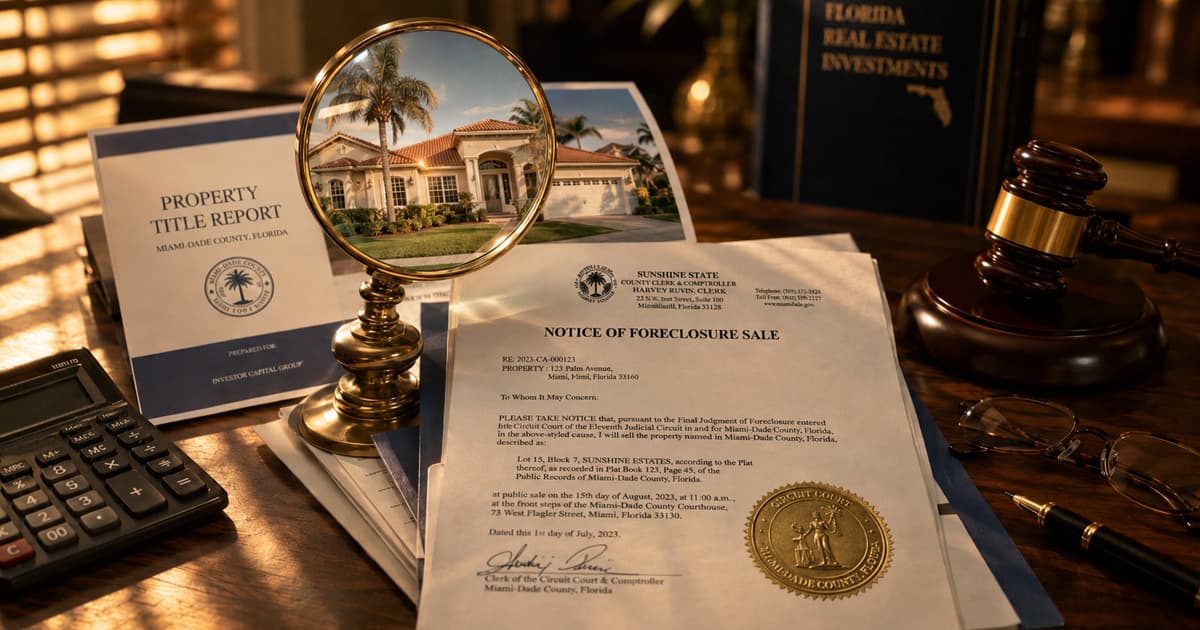
The deep-discount deal you picture at the courthouse steps is real. So is the investor standing next to you who just overpaid by $40,000 because he skipped his homework. A Florida foreclosure auction can hand you a property at a meaningful discount to market — or saddle you with a senior mortgage, a code-enforcement lien, and a renovation you were never allowed to inspect. The difference between those two outcomes is almost entirely the due diligence you finish before you ever place a bid.
This is a pre-bid checklist for investors buying foreclosures at Florida's online auctions: how the sale works, what to research, which liens survive, and how to set a maximum bid you won't regret. It closes with the case for reaching distressed owners earlier — during the pre-foreclosure window — where the math and the information both tilt in your favor.
Why Florida Foreclosure Auctions Are So Competitive
Florida is the most active foreclosure market in the country. For all of 2025, the state posted the nation's highest foreclosure rate — one filing for every 230 housing units — and recorded 34,336 foreclosure starts, second only to Texas, according to ATTOM's Year-End 2025 U.S. Foreclosure Market Report. Lakeland led every metro in the nation, with one filing for every 145 housing units.
High volume cuts both ways. It means more properties cross the auction block in Florida than almost anywhere else — and it means more bidders chasing them. In hot counties, well-located homes routinely get bid up to within a few percent of retail, which is exactly where undisciplined buyers get hurt. Volume is opportunity only if your research keeps you from overpaying.
How a Florida Foreclosure Auction Works
Florida is a judicial-foreclosure state: the lender sues, and a judge orders the property sold. Under Florida Statute 45.031, the court sets the sale for a date "not less than 20 days or more than 35 days" after the judgment, and notice is published for two consecutive weeks beforehand.
Almost every Florida county now runs the sale online through a clerk-operated auction site rather than on the courthouse steps. To bid, you register and post a deposit — and the statute is specific: "the successful high bidder shall post with the clerk a deposit equal to 5 percent of the final bid." Most county clerks require that deposit to be funded in advance and the balance paid fast. St. Johns County, for example, states the balance "and court registry fees are due by 2:00 PM EST of the following business day."
Win the bid and pay on time, and the clerk files a certificate of sale. If no objection is filed within 10 days, the clerk issues the certificate of title and the property is yours. There is no financing contingency, no inspection period, and no do-over — which is why everything that matters has to happen before the gavel.
The Pre-Bid Due Diligence Checklist
Treat every auction property as guilty until your research proves it's a deal. Here is the sequence experienced Florida investors run on each parcel before they settle on a number.
1. Identify which lien is foreclosing
The single most expensive mistake at auction is buying a junior lien's foreclosure and inheriting the senior mortgage. When a first mortgage forecloses, junior liens that were properly named in the suit are generally wiped out. But when a second mortgage or an HOA forecloses, the first mortgage usually survives — and you take title subject to it. Pull the case docket and the final judgment, confirm what's being foreclosed, and know where it sits in the lien stack before anything else.
2. Search title for liens that survive the sale
County clerks are blunt about this. As St. Johns County's foreclosure FAQ puts it: "The winning bidder takes title to the property subject to all defects, liens, encumbrances... It is the bidder's responsibility to perform all research regarding the property, including the value, title defects, liens, mortgages or other encumbrances. The Clerk's Office does not guarantee a clear title." Run the chain of title and search for surviving encumbrances — senior mortgages, unpaid property taxes, municipal and code-enforcement liens, and association dues.
3. Check for a federal tax lien
An IRS lien deserves its own line. Even when a federal tax lien is junior and is extinguished by the sale, 26 U.S.C. § 7425 gives the United States a 120-day right to redeem the property after the sale — meaning the IRS can buy it back out from under you within that window. If the title search turns up a federal tax lien, price in that risk or move on.
4. Establish ARV and a realistic market value
Your after-repair value (ARV) is the ceiling on everything. Pull recent comparable sales in the immediate neighborhood — not county-wide averages — and stay conservative. Auction adrenaline is built to make you forget your comps; write the number down beforehand and treat it as a hard cap.
5. Budget for repairs you can't inspect
You almost never get inside an auction property. Many are occupied — by the former owner or a tenant — which adds an eviction timeline and cost on top of repairs. Assume the worst-case condition consistent with what you can see from the street and from public records, and pad your rehab budget for the surprises you can't yet see. Fix-and-flip investors who win at auction are the ones who over-reserve for repairs, not under.
6. Account for the owner's right of redemption
Until the sale is final, the homeowner can still cancel it. Under Florida Statute 45.0315, the borrower may redeem "at any time before the later of the filing of a certificate of sale by the clerk of the court or the time specified in the judgment." Plenty of listed auctions get canceled or rescheduled at the last minute for exactly this reason. Don't fall in love with a property that may never reach the block.
7. Calculate your maximum bid
Your max bid is ARV minus everything: repairs, surviving liens, holding and closing costs, and the profit margin that makes the deal worth the risk. Set it before the auction opens. And remember that overbidding doesn't just thin your margin — under Florida Statute 45.032, any surplus above what's owed goes back to the former owner of record, not to you. Every dollar over your number is a dollar you simply give away.
Which Liens Survive a Florida Foreclosure?
This is the table to internalize. "Survives" means the obligation stays attached to the property and becomes your problem after you take title.
| Encumbrance | Survives a 1st-mortgage foreclosure? | Notes |
|---|---|---|
| Senior mortgage (recorded before the foreclosing lien) | Yes | You take title subject to it. |
| Junior mortgages and liens named in the suit | No | Extinguished — but only if they were properly joined in the case. |
| Unpaid property taxes | Yes | Ad valorem tax liens are a "first lien, superior to all other liens" (Fla. Stat. 197.122). |
| Code-enforcement liens | Usually no | Florida code liens are not "superpriority"; one recorded after the mortgage is generally extinguished by a first-mortgage foreclosure. Check the recording date. |
| Special assessments / certain municipal liens | Can survive | Some carry statutory priority — verify each with the city and county. |
| HOA / condo association dues | Partially | A first-mortgagee safe harbor caps some past-due amounts, but a third-party buyer can owe more — and a balance can still carry. |
| IRS federal tax lien | Sometimes | Extinguished if junior and properly noticed — but a 120-day redemption right applies. |
None of this is legal advice, and the specifics turn on what was recorded and who was named in the case — which is exactly why the title and lien search in steps 1–3 is non-negotiable.
A Worked Example: Setting a Safe Maximum Bid
Numbers make the discipline concrete. Say a three-bed in a Florida suburb has an ARV of $400,000 and you've verified the first mortgage is what's foreclosing, so junior liens wash out. Your homework turns up:
- ARV (conservative comps): $400,000
- Estimated repairs (sight-unseen, padded): −$55,000
- Surviving property-tax lien: −$9,000
- Holding, closing, and selling costs (~12%): −$48,000
- Target profit margin: −$60,000
Subtract it all and your maximum bid is $228,000 — and not a dollar more, no matter how the bidding feels in the moment. The investor who "rounds up to $250,000 because it's such a nice house" just converted a $60,000 margin into $38,000 while taking on 100% of the risk. The checklist isn't bureaucracy; it's the number that keeps a good-looking auction from becoming a bad deal.
Why Many Investors Skip the Auction Entirely
Step back and look at where the auction sits in a property's distress timeline, and a pattern emerges: the courthouse sale is the single point with the most competition and the least information. You can't go inside. You can't get clean title insurance. You have to settle in cash by the next business day. And you're bidding against every other investor who saw the same public notice. By design, the auction strips away nearly every advantage a careful buyer normally has.
The same property was reachable weeks or months earlier — when the lender first filed suit and recorded a lis pendens. In that pre-foreclosure window the owner can still answer the phone, still let you walk the interior, and still negotiate terms that work for both sides. You can offer a graceful exit ahead of the credit-wrecking sale instead of competing on price at the steps. For wholesalers and flippers alike, that's a structurally better place to do business. (We covered the legal signal that opens this window in our guide to Florida lis pendens.)
That's the entire premise behind how we built PocketLeads. We track Florida pre-foreclosure and lis pendens filings sourced directly from county court records — across four active counties, Collier, Lee, Sarasota, and Pinellas, and expanding — enriched with property and equity data and skip-traced contact information where available, and delivered the same day. You reach the owner while there's still a deal to make, instead of waiting to outbid a crowd for a house you've never seen. Browse Lee County motivated seller leads to see what that looks like in one market.
Frequently Asked Questions
Can you inspect a property before a Florida foreclosure auction?
Almost never inside. Auction properties are sold as-is, and many are still occupied, so your condition assessment usually relies on exterior observation, public records, and conservative repair assumptions.
How much deposit do I need to bid at a Florida foreclosure auction?
Florida Statute 45.031 requires the winning bidder to post a deposit equal to 5% of the final bid, and most county clerks require it to be funded before the sale, with the balance due by the next business day.
Do liens get wiped out at a foreclosure auction?
Some do, some don't. Junior liens properly named in a first-mortgage foreclosure are generally extinguished, but senior mortgages, property taxes, and certain municipal assessments survive and become the buyer's responsibility. A full title search is essential.
Can the homeowner stop the auction at the last minute?
Yes. Under Florida Statute 45.0315, the borrower can redeem and cancel the sale any time before the certificate of sale is filed, which is why auctions are frequently canceled or postponed.
What happens to extra money if I overbid?
Surplus above the amount owed doesn't go to the winning bidder. Under Florida Statute 45.032, it is returned to the former owner of record (after any subordinate lienholders), so overbidding only gives money away.
Is buying pre-foreclosure leads better than bidding at auction?
For many investors, yes. Reaching an owner during the pre-foreclosure window lets you inspect the home, negotiate terms, and avoid a bidding war — advantages the auction removes. It's why platforms like PocketLeads focus on delivering pre-foreclosure and lis pendens leads early.
Reach Florida Sellers Before the Auction
Same-day pre-foreclosure and lis pendens leads across Collier, Lee, Sarasota, and Pinellas — enriched with property, equity, and contact data, and ready to work.
Get Started FreeSources: ATTOM — Year-End 2025 U.S. Foreclosure Market Report; Fla. Stat. § 45.031 (Judicial sales procedure); Fla. Stat. § 45.0315 (Right of redemption); Fla. Stat. § 45.032 (Disbursement of surplus funds); 26 U.S.C. § 7425 (Discharge of liens); St. Johns County Clerk — Foreclosure Sales FAQ.