
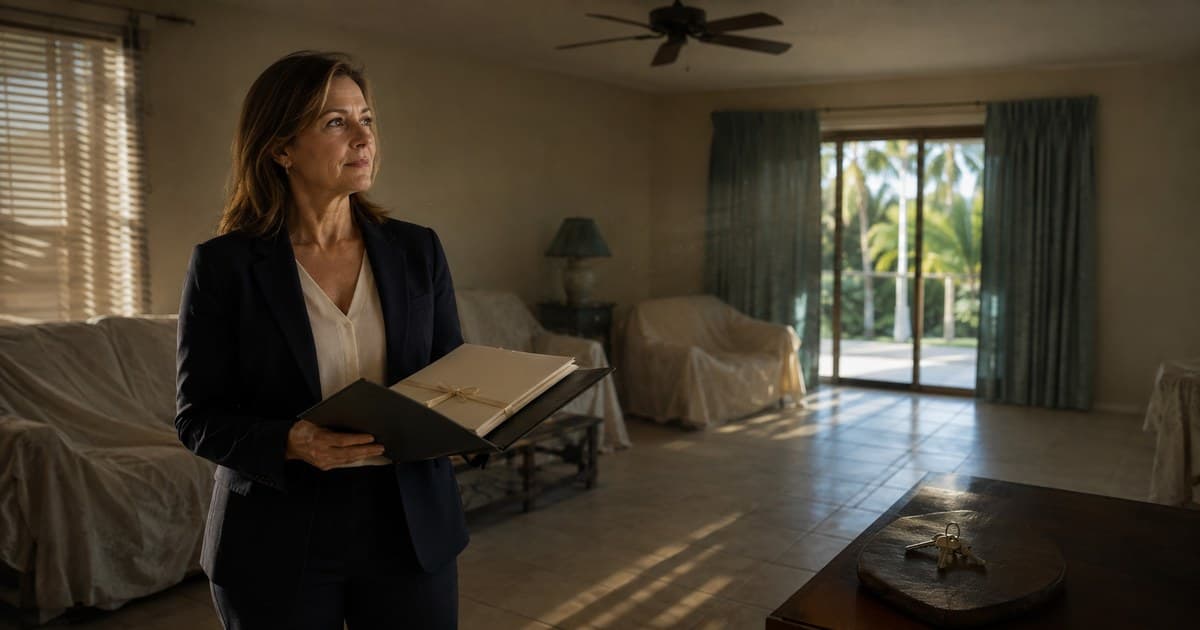
The call comes from a daughter in Ohio. Her mother's house in Lee County has been empty since March, the family wants it sold, and she would like to know what you would list it for. You run the comps, you walk the property, and three weeks later a title agent tells you the person who signed your listing agreement had no authority to sell the house. Florida probate listings fail on that exact point far more often than they fail on price.
An estate sale is not a standard sale with extra paperwork on top. It is a different transaction, and the differences are set by statute rather than local custom: who may sign, whether a judge has to bless the sale, and how little the seller can honestly tell you about the house.
How a probate listing differs from a standard listing
Every row below is a place where standard-transaction instincts point the wrong way. If you work Florida probate leads, establish these six before spending a dollar on marketing.
| What's at issue | Standard listing | Probate listing |
|---|---|---|
| Who signs | The owner or owners named on the deed | The representative — unless the house is protected homestead, which is not among the assets in the representative's hands |
| Court involvement | None | None if the will grants a power of sale; otherwise no title passes until the court confirms |
| Creditor exposure | Recorded liens run with title | Buyer takes free of estate creditor claims; mortgages and liens untouched |
| Seller knowledge | Owner has lived there, often for years | The representative may never have occupied or even seen it |
| Conflicts of interest | No special rule | A sale touched by the representative's conflict is voidable |
| What drives the clock | Financing and inspection periods | The administration, including the creditor claim period |
Who can actually sign the Florida estate sale listing agreement
Start with the sentence that decides most estate listings. Section 733.608(1), Florida Statutes, provides that "All real and personal property of the decedent, except the protected homestead, within this state and the rents, income, issues, and profits from it shall be assets in the hands of the personal representative."
Read that twice, because it inverts the intuition. Letters of Administration do not hand the representative the house. Protected homestead is excluded from the assets the representative holds and passes to the heirs or devisees by operation of law, so the people who can sign are the people who now own it — possibly a surviving spouse and several children in three states, not the one relative who called you.
Where a spouse survives along with descendants, section 732.401 sets the default: the spouse takes a life estate with a vested remainder to the descendants per stirpes. The spouse may instead elect an undivided one-half interest as a tenant in common, within six months after death, and "Once made, the election is irrevocable." A life estate and a remainder are two separate signatures on any deed conveying the whole property.
The statute acknowledges the ambiguity: section 733.608(2) lets a representative take possession of apparent homestead property purely to preserve and insure it "pending a determination of its homestead status." That determination belongs to the court — not the tax roll, and certainly not a listing agent. Note too that the powers exercisable without a court order under section 733.612 cover disposing of assets "excluding real property in this or another state." A representative can hire you without a court order, but hiring you and being able to convey the house are different questions. Our post on Florida homestead and probate covers the constitutional side in more depth.
Whether the sale needs a court's blessing
Whether a personal representative can sell real property in Florida without a judge signing off comes down to one document: the will.
Where the will confers a specific power to sell or mortgage real property, or a general power to sell any estate asset, section 733.613(2) allows a sale "without authorization or confirmation of court," and it "need not be justified by a showing of necessity." This is the clean case. It closes like a normal transaction.
Where the estate is intestate, or the will grants no power of sale, section 733.613(1) still permits a sale — but attaches a hard condition: "No title shall pass until the court authorizes or confirms the sale." Your contract can be signed and your buyer funded, and title still does not move until the court acts. An agent who sets an offer deadline before reading the will is guessing at their own timeline.
What the buyer actually receives at closing
Estate transactions carry a reputation for creditor risk that the statute does not support. Section 733.613(3) is unusually direct: in a sale under a specific power to sell, or under a court order authorizing or confirming it, "the purchaser or lender takes title free of claims of creditors of the estate and entitlements of estate beneficiaries, except existing mortgages or other liens against real property are not affected."
Most buyer's agents do not know this. The estate's unsecured creditors do not follow the house; the recorded mortgages and liens do, exactly as on any other house. The creditor process still shapes the calendar, though: under section 733.702(1), claims are generally barred unless filed by the later of three months after first publication of the notice to creditors, or thirty days after service on a creditor entitled to be served. Estate counsel often wants that window resolved before distributing proceeds.
Disclosure when the seller never lived in the house
This is where being a probate real estate agent in Florida differs most from ordinary practice, and where risk quietly shifts onto you. Florida's statutory flood disclosure, section 689.302, must be completed and given to the buyer at or before the contract is signed. Look at what it asks: whether the seller knows of flooding that damaged the property "during Seller's ownership of the property," whether the seller has filed a flood claim, and whether the seller has received flood assistance. An estate that has held the house four months, through a representative who lives out of state, can answer all three truthfully and tell the buyer almost nothing. The form is not defective — it is simply calibrated for a seller who lived there.
That matters, because nearly half of the estate properties in our four counties sit in a FEMA flood zone. The zone is public information; the point is that nobody in the transaction is assigned to go find it.
Your own duty does not soften because your seller's knowledge is thin. Florida presumes a licensee operates as a transaction broker unless another relationship is established in writing, and section 475.278(2)(d) makes one of that broker's duties "Disclosing all known facts that materially affect the value of residential real property and are not readily observable to the buyer." That attaches to your knowledge, independent of the representative's. Florida's common-law rule from Johnson v. Davis separately obliges a seller aware of such defects to disclose them, and per Florida Realtors' law library that duty survives an "as is" contract.
The conflict-of-interest trap
One more rule with no counterpart in a standard listing. Under section 733.610, any sale to the personal representative — or to their spouse, agent, or attorney, or to an entity in which any of them holds a substantial beneficial or ownership interest — or any transaction affected by a conflict of interest on the representative's part, is "voidable by any interested person except one who has consented after fair disclosure," unless the will authorized it or the court approved it after notice. This comes up more often than you would expect, usually innocently: the representative is also an heir and wants to buy out the siblings. The deal is not forbidden — it needs the paperwork the statute names, and a listing agent who spots the conflict early is worth their commission twice over.
What Florida probate listings actually look like as a pool
Florida's resale market is not starved for buyers — Florida Realtors reported 26,036 single-family closed sales in June 2026, up 9.3% year over year, at a median price of $432,000 and a 4.5-month supply. The scarce resource for most agents is not demand. It is the listing. Here is what the estate pool looks like across the four Florida counties we cover — Collier, Lee, Sarasota and Pinellas County — since May 1, 2026, across 3,435 estate-related properties.
- 78.0% carry a homestead exemption on the county tax roll. That is not the court's determination of protected homestead status, but it is a strong signal that section 733.608(1) is about to matter to your listing agreement.
- 62.7% show more than one owner of record. More than one name on the deed means more than one question to answer before anyone signs.
- Median estimated value is about $393,000, and the median house was built in 1987.
- These are not all starter homes. 21.9% fall between $400,000 and $600,000, 15.1% between $600,000 and $1 million, and 11.4% are above $1 million. Combined, the pool carries more than $2 billion in estimated market value.
- Fewer than 1 in 20 were flagged as on the market at the most recent valuation refresh — 4.3%, against 8.8% for pre-foreclosure properties. You are not competing for this inventory on the MLS.
That last point is worth sitting with. The competition for an estate listing is not other agents holding open houses. It is investors and wholesalers mailing the same families, usually earlier, offering certainty instead of a marketing plan — which makes this a timing problem, one we mapped in the estate timeline from obituary to transfer.
Get to the estate before the postcards do
PocketLeads tracks estate filings across Collier, Lee, Sarasota and Pinellas counties and delivers them the same day, with the property, parcel details, estimated value and equity, and contact information attached. It is built for Florida agents who would rather work a listing appointment than a cold farm, and the same probate leads for realtors feed is available county by county, each lead type on its own subscription.
Get Started Free and see the estate filings in your county from this week.
Frequently asked questions
Can a personal representative sell real property in Florida without court approval?
Yes, when the will confers a specific power to sell real property or a general power to sell any estate asset — section 733.613(2) then permits a sale "without authorization or confirmation of court." Otherwise section 733.613(1) applies and no title passes until the court authorizes or confirms the sale.
Who signs the listing agreement when selling a house in probate in Florida?
It depends on whether the house is protected homestead, which section 733.608(1) excludes from the assets in the representative's hands. Homestead generally passes to the heirs or devisees, and they convey it. Ask for the Letters of Administration and the will before taking the listing.
Do estate creditor claims follow the buyer after closing?
No. Under section 733.613(3), a purchaser in a sale under a specific power to sell, or under a court order authorizing or confirming it, "takes title free of claims of creditors of the estate and entitlements of estate beneficiaries." Existing mortgages and recorded liens are expressly not affected.
What disclosures apply when the seller is an estate?
The same statutory ones. Section 689.302's flood disclosure is still required at or before contract, though its questions are framed around flooding "during Seller's ownership." Section 475.278(2)(d) separately requires the licensee to disclose known facts materially affecting value that are not readily observable to the buyer.
How do real estate agents find probate listings in Florida?
Estate filings are public record, and some agents work them at the courthouse directly. The difficulty is timing and volume across several counties at once. PocketLeads monitors filings in Collier, Lee, Sarasota and Pinellas counties and delivers matched properties the same day — see PocketLeads for realtors, or our breakdown of how the probate lead providers compare.
This article is general information about Florida law and is not legal advice. Estate transactions turn on the specific will, the specific court file, and the specific facts of the property. Advise your clients to work with a Florida probate attorney.