
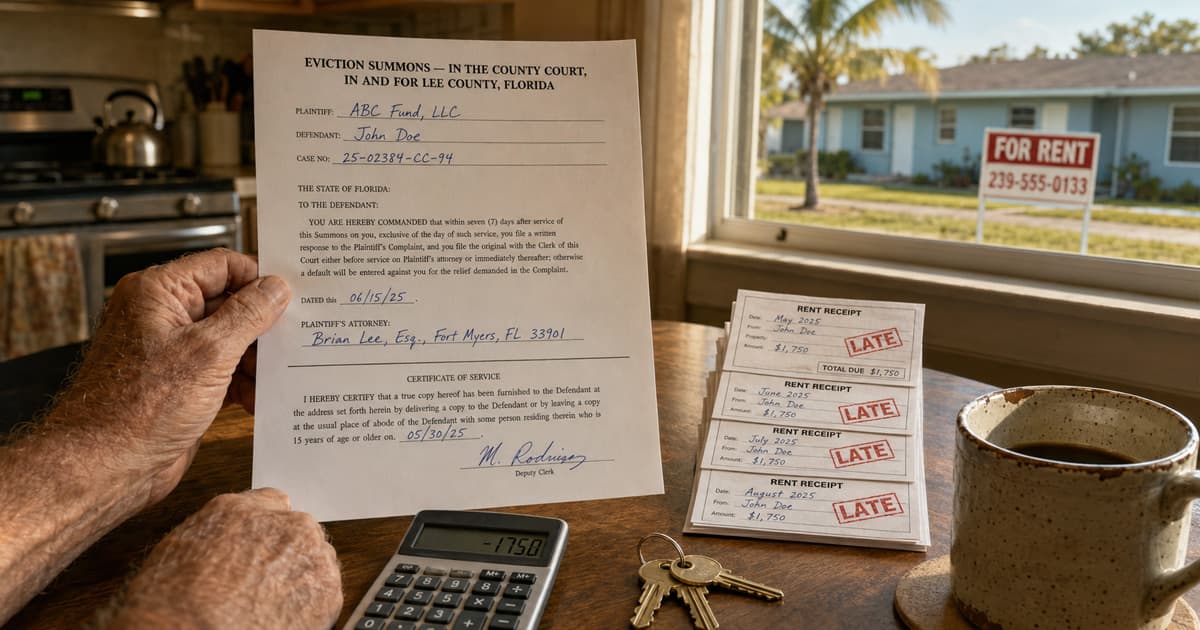
If you target Florida investment property, tired landlord leads in Florida are one of the clearest motivated-seller signals you can buy. When a landlord files an eviction, they are spending money, time, and emotional energy on a tenant who has stopped paying or stopped complying — and a meaningful share of those landlords decide that being a landlord is no longer worth it. The eviction filing itself is the breadcrumb that tells you which property owners are at that breaking point.
This guide walks through the Florida eviction process step by step — the statutory notice periods, the courthouse procedure, the recent law changes — and shows how investors source Florida eviction leads from the public-record filings the same day.
Why Eviction Filings Signal a Tired Landlord
Foreclosures tell you a homeowner is in distress. Probate tells you an heir has inherited a house they may not want. An eviction filing tells you the property owner is operating a rental that is not working. The economics behind that signal are unforgiving:
- Lost rent. Most evictions begin with a 3-day notice for nonpayment, meaning the landlord is already at least one rent cycle behind by the time the case hits the docket.
- Filing fees and attorney costs. The landlord pays to file the case, serve the summons, and either represent themselves or hire counsel.
- Continued holding costs. Mortgage, insurance, taxes, and utilities continue to accrue while the eviction proceeds.
- Property condition risk. Tenants in active eviction frequently leave the unit in worse shape than they found it.
Stack one or two of those experiences together and a landlord starts running a different math problem: do I keep buying problems, or do I sell the property as-is and walk away? That is the moment investors with cash offers, fast closings, and a willingness to inherit a problem tenant become genuinely useful — and why eviction-filing data sits alongside Florida pre-foreclosure leads and Florida probate leads in any serious investor's distress-signal stack.
Repeat filers are the strongest signal. A landlord who has filed three evictions in two years on different properties is not having bad luck — they are signaling that they would rather be doing something else with their capital.
But not every filer is a worn-out individual, and it pays to know which one you are calling. Measured across the houses and condominiums behind eviction filings in our four counties, only 44.3% have nothing but people on title; 46.7% are held by a company, against 7.7% of the housing stock generally. A business does not get tired — it reprices, refills the unit and moves on. The tired-landlord pitch lands on the individual owner; the company-titled half of the list needs a different opening line entirely. We broke that down in Florida property owned by an LLC, a trust, or an estate.
The Florida Eviction Process Step by Step
Florida residential evictions are governed by Part II of Chapter 83 of the Florida Statutes, the Florida Residential Landlord and Tenant Act. The process is faster than in most states — a fact every Florida investor should understand before approaching a tired landlord. Here is the sequence:
1. The Pre-Suit Notice
Before a landlord can file in court, they must serve the correct written notice. The notice type depends on what the tenant did or didn't do.
3-Day Notice — Nonpayment of Rent
Under F.S. 83.56(3), when rent is overdue the landlord delivers a written demand for payment "within 3 days (excluding Saturday, Sunday, and legal holidays)." Florida statute clarifies that "Legal holidays for the purpose of this section shall be court-observed holidays only" — so a three-day notice served on a Tuesday with a Friday court-observed holiday could give the tenant until Monday to pay.
If the tenant pays in full within the window, the case is over. If they don't, the landlord can file the eviction the next business day.
7-Day Cure Notice — Curable Lease Violations
For violations that can be fixed — unauthorized pet, unauthorized occupant, parking issues — F.S. 83.56(2)(b) requires the landlord to "demand that you remedy the noncompliance within 7 days." The notice also warns: "If this same conduct or conduct of a similar nature is repeated within 12 months, your tenancy is subject to termination without further warning."
7-Day Non-Curable Notice — Material Violations
For more serious violations — intentional property damage, repeated noncompliance, or conduct that endangers others — F.S. 83.56(2)(a) allows immediate termination with 7 days to vacate. The statutory language is direct: "You are advised that your lease is terminated effective immediately. You shall have 7 days from the delivery of this letter to vacate the premises."
Month-to-Month Termination — 30 Days
For tenancies without a specific term, F.S. 83.57 sets the notice periods. Under current Florida law, terminating a month-to-month tenancy now requires "not less than 30 days' notice prior to the end of any monthly period." Other tenancy types: week-to-week is 7 days, quarter-to-quarter is 30 days, year-to-year is 60 days.
2. Filing the Eviction Complaint
If the notice expires without compliance, the landlord files the complaint in the county court of the county where the rental property is located, as required by F.S. 83.59. The case proceeds under Florida's "summary procedure" — meaning the court is expected to advance the case ahead of standard civil cases.
3. The Tenant's 5-Day Window
Florida's summary procedure statute, F.S. 51.011, gives the tenant only 5 days after service of process to file an answer. Tenants who fail to answer in 5 days, or who fail to deposit any disputed rent into the court registry, often see default judgments.
4. Judgment and Writ of Possession
Once judgment is entered for the landlord, the clerk issues a writ of possession to the sheriff, governed by F.S. 83.62. The sheriff then posts the writ on the premises. The statute makes one detail particularly important for investors: the tenant gets "24 hours' notice conspicuously posted on the premises," and "Saturdays, Sundays, and legal holidays do not stay the 24-hour notice period." A writ posted Friday afternoon means the sheriff can return Saturday afternoon to put the landlord back in possession.
What Changed: HB 1417 and the 30-Day Notice
The most consequential recent change to Florida landlord-tenant law was CS/HB 1417 (2023), signed by the Governor on June 29, 2023 and effective July 1, 2023 as Chapter 2023-314. Two changes matter for investors:
- Month-to-month notice doubled. The minimum notice to terminate a month-to-month tenancy increased from 15 days to 30 days, codified in F.S. 83.57(3).
- Statewide preemption. The bill created F.S. 83.425, expressly preempting "the regulation of residential tenancies, the landlord-tenant relationship, and all other matters covered by" the Act to the state. Local ordinances inconsistent with state law are superseded.
For a tired landlord, the 30-day month-to-month notice is yet another reason the rental business has gotten more expensive: a problem tenant who is technically not in default can take a full extra month to leave.
Florida Eviction Filing Trends 2023–2025
The volume of Florida eviction filings is sustained and, in many counties, growing. Two reliable data sources tell the story:
- Eviction Lab at Princeton measured 54.63 evictions per 1,000 renter households in Florida in 2023, up from 52.45 in 2022.
- The Legal Services Corporation Civil Court Data Initiative tracks cumulative residential filings by county since March 16, 2020. Selected Florida totals as of late 2025: Hillsborough 53,493; Pinellas 24,703; Lee 10,462; Collier 2,482.
- Eviction Lab's Tampa MSA tracker (Hillsborough + Pinellas) shows monthly residential filings ranging roughly 1,200–1,800 across 2024 and 2025 — a steady drumbeat well above the early-pandemic lows of 200–400.
- Central Florida Public Media reported in March 2025 that seven Central Florida counties hit record eviction filings in 2024, with regional eviction activity up roughly 40% since pre-pandemic.
The takeaway for an investor: every active Florida county has a measurable, recurring weekly stream of new eviction filings. Lee County and Pinellas County in particular post hundreds of filings per quarter, and the records are public on the same day they are filed.
How Investors Find Florida Eviction Leads
Public-record eviction filings have always been available — they have just been impractical to harvest at scale. Each Florida county clerk publishes their own docket, with their own URL, their own naming conventions, and their own export rules. Manually checking four counties every weekday morning before lunch is a non-starter for most investors.
PocketLeads consolidates the four active Florida counties — Collier, Lee, Sarasota, and Pinellas — into a single same-day feed of Florida eviction filings on investor-relevant residential property, joined to:
- The owner of record (not just the LLC name on the case caption — the human behind the LLC where available)
- The parcel record from the county property appraiser
- An equity estimate from current property valuation against open mortgages and liens
- Skip-traced phone numbers and mailing addresses (skip tracing is not a 100% hit rate)
- Repeat-filer flags so you can prioritize landlords with multiple filings
One scope note, because it changes how you should read the county totals above. This covers single-family homes, condominiums and small multi-family property — the kinds of building an investor can actually buy. Evictions at large purpose-built apartment complexes make up much of the raw county filing count and are deliberately excluded: a unit turning over in a 200-unit building is not a transaction anyone can act on. The county figures cited earlier are the whole docket; what reaches your dashboard is the slice of it that is a deal.
Two investor profiles get the most use out of this data:
- Wholesalers. Tired landlords are open to as-is, cash, fast-close offers, which is exactly the wholesaler value proposition. See how wholesalers use PocketLeads.
- Buy-and-hold investors. A tired landlord with a small portfolio often wants to sell more than one property at a time. Buy-and-hold investors can pick up an entire mini-portfolio at a discount and assume the operational headaches the prior owner no longer wants.
How to Approach a Tired Landlord
Tired landlords are not motivated for the same reason a probate heir is. The script changes:
- Lead with empathy, not opportunism. "I saw you have a court matter on the property at [address]" reads as predatory. "I work with rental property owners around [city] who are tired of dealing with non-paying tenants" reads as understanding.
- Offer the headache transfer, not just the price. The seller's pain is the tenant, the repairs, and the carrying cost. A real estate offer that closes around the tenant — even at a discount — is often more attractive than a higher offer contingent on a clean turnover.
- Make the close calendar concrete. "We can close in 21 days even if the tenant is still in place" beats "we pay cash."
- Time the outreach. The first 7–14 days after the eviction filing — while the landlord is still bleeding rent and stressed about the hearing — is when sellers are most receptive.
Frequently Asked Questions
How are eviction leads different from pre-foreclosure leads?
Pre-foreclosures signal that the homeowner is behind on a mortgage. Evictions signal that the property owner is behind on rental income. Both produce motivated sellers, but the eviction filer is usually a multi-property owner, often willing to discuss a portfolio sale, while the pre-foreclosure owner is typically owner-occupied. Many investors run both lists in parallel — see our pre-foreclosure leads guide for the other side.
Are Florida eviction filings public record?
Yes. Florida eviction complaints are filed in county court and are publicly searchable through each county clerk's case search system the day they are filed. PocketLeads consolidates these filings across active Florida counties so investors don't have to check each clerk's site individually.
How long does the Florida eviction process take?
From the day the 3-day notice is served, an uncontested Florida residential eviction can be over in roughly 3–4 weeks: 3 days for the notice, the time to draft and file the complaint, 5 days for the tenant to answer under F.S. 51.011, judgment soon after if no answer, and a 24-hour writ posting under F.S. 83.62. Contested cases — disputed amounts, defective notices, tenant counterclaims — take longer.
Should I focus on landlords with multiple eviction filings?
Yes. Repeat filers are the strongest tired-landlord signal. A landlord who has filed two or three evictions across multiple properties in 18 months is signaling that the rental business is wearing them out — and is far more likely to entertain a sale than a one-off filer dealing with a single bad tenant.
What if the tenant is still in the property when I want to buy?
Common — and frequently the seller's biggest pain point. You can purchase the property and either (a) wait out the existing eviction and take possession yourself, (b) negotiate cash for keys with the tenant after closing, or (c) keep the tenant if they are now paying. The right answer depends on your hold strategy. Building "tenant in place" pricing into your offer keeps the negotiation clean.
Did Florida change its landlord-tenant laws recently?
Yes. CS/HB 1417 took effect July 1, 2023, increasing the minimum notice to terminate a month-to-month tenancy from 15 to 30 days and preempting local landlord-tenant ordinances to the state. The 3-day, 7-day cure, and 7-day non-curable notices under F.S. 83.56 were not changed.
Get Florida Eviction Leads the same day
PocketLeads pulls eviction filings from the four active Florida counties — Collier, Lee, Sarasota, and Pinellas — and delivers them the same day, fully enriched with owner, parcel, equity, and skip-traced contact data. Subscriptions are per lead type, so you can start with eviction leads only and add probate, divorce, or pre-foreclosure later.
Get Started Free and see the day's tired-landlord filings in your dashboard the same day they hit the docket.