
Across the probate leads in our four counties opened since July 1, 22% had a will filed with the clerk first, as its own case, a median of three weeks before anyone petitioned to open the estate. That is the practical reason to learn how to search Florida probate records yourself: the probate docket most people watch is often not the first record in the file. This guide covers what the free clerk searches in Pinellas, Lee, Collier and Sarasota counties actually show, what Florida law keeps offline, and four mistakes that make a search come up short.
What a Florida probate records search shows, and what it hides
Florida court records are public, but online access is tiered. The statewide access standards adopted by the Florida Supreme Court in AOSC24-65 give the general public, searching without a registration agreement, "no remote access to images of records in cases governed by the … Florida Probate Rules, pursuant to §28.2221(5)(a), F.S." That statute bars posting images of probate court files "on a publicly available Internet website for general public display."
So an anonymous search gets you an index, not a file. To read the petition, the will or the inventory, you either register with the clerk or go to the courthouse. Under the same standards, registered users and the public in clerks' offices can view probate images on request.
Even the index is thinner than it looks. The Pinellas and Lee portals both warn that probate case searches "will not return complete results if searching as the general public." If you are building a list from the public view, you are building it from a partial result set.
How to search probate records in Pinellas, Lee, Collier and Sarasota
Each clerk runs its own portal, so searching Pinellas County probate records starts somewhere different, under different rules, than searching Collier County probate records. Here is what each office publishes as of October 2026.
| County | Public probate case search | Probate images online | Copies |
|---|---|---|---|
| Pinellas | Court Records Public View, no login | Registered users only; public view terminals at Clerk locations | $1.00/page; $2.00 to certify |
| Lee | Court Records Inquiry, by case number, date and case type, or party name | Limited for probate; registered-user access needs no form and no fee | $8.00 per e-certified document |
| Collier | Search Online Cases, no registration for public view | Registered users only; public view terminals at Clerk locations | $1.00/page; $2.00 extra per certified document |
| Sarasota | ClerkNet, General Public User Access | Registration offers a Registered User account type | $1.00/page; $2.00 to certify |
Lee is the easiest upgrade: its FAQ states that registered-user access requires no registration form and that there are no fees to view records remotely. Lee also notes that wills cannot be e-filed, so deposits arrive in person or by mail. Sarasota publishes the steps for a will search on its website: choose the Probate/Guardianship/Mental Health court type, pick the case type "Wills for Safekeeping," and enter a date range.
For local volume, see Pinellas County probate leads, Lee County probate leads, Collier County probate leads and Sarasota County probate leads.
Why the will filing often comes first
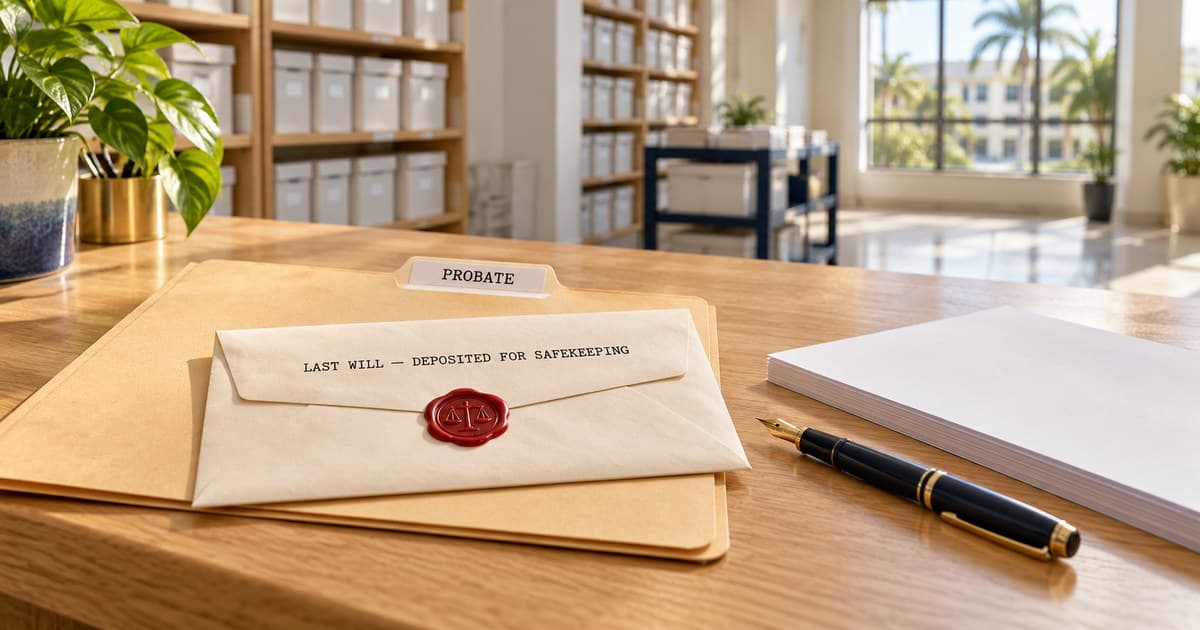
That early record is a Florida will deposit, and it exists because the law forces it. Under F.S. 732.901(1), the custodian of a will "must deposit the will with the clerk of the court having venue of the estate of the decedent within 10 days after receiving information that the testator is dead." The clerk must keep the original for at least 20 years. A deposited will does not open an estate by itself. It just sits in the clerk's index, searchable, until someone files a petition.
Here is how often that gap shows up in our own data. We looked at 743 probate leads in Collier, Lee, Pinellas and Sarasota counties opened between July 1 and mid-September 2026:
- 166 of them, or 22.3%, had a will filed with the clerk first, as a separate case.
- The will came a median of 22.5 days before the probate filing. The middle half fell between 9 and 38 days.
- The pattern held in every county: 31.7% in Collier, 30.2% in Sarasota, 18.3% in Lee and 17.0% in Pinellas, with medians between 19 and 25 days.
Read those lead times as a floor. Our records begin in May, so a will deposited long before the estate opened is undercounted here.
The takeaway is blunt: if you only watch the probate docket, you are about three weeks late on a fifth of the market. Will filings are one of the pre-probate signals covered in our comparison of pre-probate vs. probate leads, and the timing above is why they deserve their own search.
Four mistakes that make a probate search come up short
1. Treating the public view as complete. Pinellas and Lee say outright that it is not. A registered account is the cheapest fix, and in Lee it is free with no form.
2. Trusting the clerk's summary administration page. As of October 1, the Lee, Collier and Sarasota probate pages still describe summary administration as available when the estate "does not exceed $75,000." The statute moved: F.S. 735.201(2) now reads "does not exceed $150,000," and its history cites chapter 2026-57. Only Pinellas shows the current figure. Our Florida summary administration guide covers the change. Cite the statute, not the help page.
3. Waiting for the notice to creditors. It runs "once a week for 2 consecutive weeks" under F.S. 733.2121(2), and creditor claims are generally barred after three months from first publication under F.S. 733.702(1). It is a useful marker, but by the time it appears in the newspaper the estate is already open. It is the last signal, not the first. Our step-by-step Florida probate guide lays out the full sequence.
4. Expecting the court file to tell you about the house. A probate record is about a person and an estate. It is not organized around property, equity or a mailing address you can act on. That is the gap Florida probate leads from PocketLeads are built to close: estate filings, will filings included, delivered the same day and tied to the property with equity data. For an investor, that means reaching an estate before the notice to creditors runs (see PocketLeads for wholesalers). For an agent, it means meeting a family before they need a listing (see PocketLeads for realtors).
Coverage today is Collier, Lee, Sarasota and Pinellas, with more Florida counties coming. Start your free trial and compare this week's estate filings with the search you would otherwise run by hand.
Frequently asked questions
Are Florida probate records public?
Yes, but online access is limited. F.S. 28.2221(5)(a) bars posting images of probate court files on a publicly available website, so anonymous users can search the index while documents are viewable by registered users or in person at the clerk's office.
How do I find out if a will was filed in Florida?
Search the clerk's index in the county where the person lived. Under F.S. 732.901(1), the custodian of a will must deposit it with the clerk within 10 days of learning of the death. In Sarasota, search the case type "Wills for Safekeeping" with a date range.
How much do copies of probate documents cost?
Pinellas, Collier and Sarasota each list $1.00 per page, with a $2.00 certification charge. Lee lists $8.00 per e-certified court document.
What does CP mean in a Florida case number?
CP is the court-type code for probate and guardianship under Florida's uniform case numbering system. The probate division also uses MH and GA.
This article is general information, not legal advice. For questions about a specific estate, consult a Florida probate attorney.