
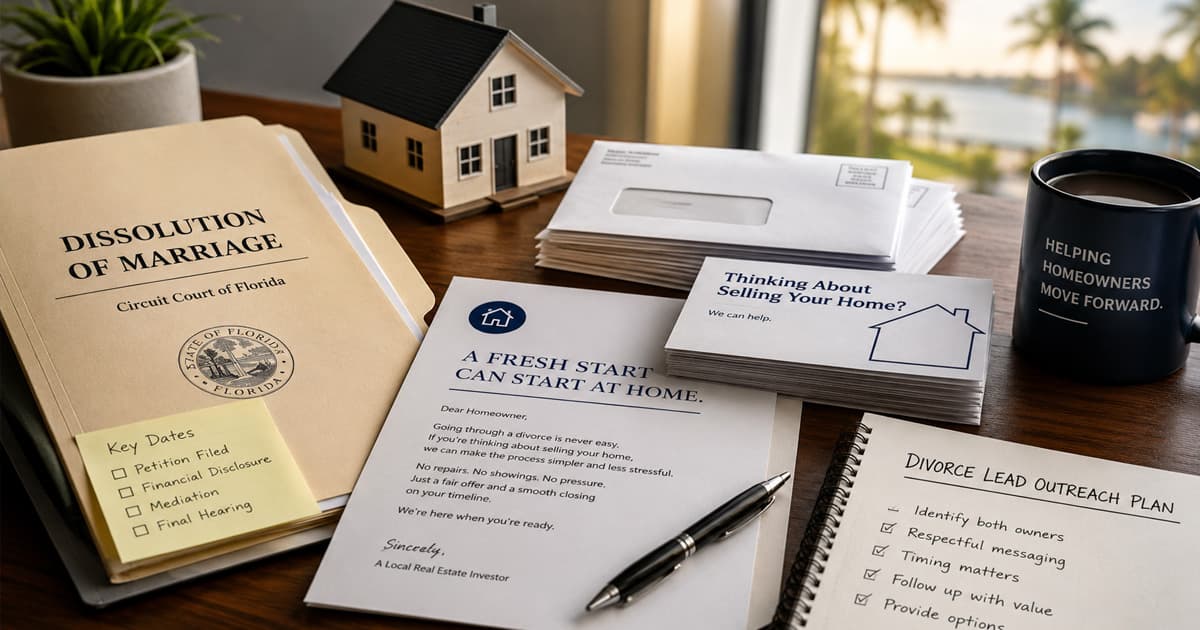
If you buy or list houses from motivated sellers in Florida, a divorce filing is one of the most reliable signals you can work — and one of the most commonly botched. Most investors point the same generic "we buy houses" mailer at a fresh dissolution case and then wonder why the response is so thin. The problem isn't the list. It's that how to work Florida divorce leads is genuinely different from working a probate or a pre-foreclosure: two living owners who may not agree, a home that's a contested asset, and a court — not your pitch — creating the motivation.
This is a playbook for the how, not the what. If you want the fundamentals first, read our Florida divorce leads guide and come back. Below: the timeline that drives your timing, the two-owner dynamic that drives your script, a respectful touch cadence, and the tone lines you must never cross.
Why a Florida divorce filing signals a motivated seller
Florida is a no-fault divorce state. The only ground a petitioner has to assert is that the marriage is "irretrievably broken" (Fla. Stat. § 61.052) — no proof of wrongdoing, no waiting on fault. That keeps the pipeline large and steady: in fiscal year 2024-25, Florida courts logged 72,735 dissolution-of-marriage filings (plus 12,261 simplified dissolutions), and dissolution alone made up 30.3% of all circuit family-court filings, per the Florida Office of the State Courts Administrator's Statistical Reference Guide.
Divorce produces a motivated seller so often because of one asset. For most couples the marital home is the largest thing they own together, and when the marriage ends the court has to divide it. Florida's equitable-distribution statute says that in splitting marital assets, the court "must begin with the premise that the distribution should be equal" (§ 61.075). You can't cut a house in half — so when neither spouse can buy the other out, the practical answer is to sell and split the proceeds, which is what makes working divorce real estate leads worthwhile. The motivation is structural, not something your postcard has to manufacture.
One caveat shapes your offer math: divorce homes differ from probate homes on equity. Probate estates often involve older owners who paid off the mortgage years ago and sell free and clear (we covered that in how divorce and probate leads compare). Divorce owners are usually working-age, so the property more often still carries an active mortgage, and any equity is split two ways — so more of these deals land near market value or head to a conventional listing than to a deep-discount cash buy.
The Florida divorce timeline — the windows that drive outreach
"Filed" does not mean "for sale." The single most useful thing you can internalize about the Florida divorce timeline is that the case moves through stages, and the property usually reaches the market somewhere in the middle or at the end — not on day one. Mapping your outreach onto those stages is the whole game.
| Stage | What happens | Why it matters for outreach |
|---|---|---|
| Petition filed | Case opens; it becomes a public record | Your earliest signal — but emotions are raw; do not mail day one |
| ~Day 20 | Earliest a final judgment can be entered (§ 61.19) | A floor, not a finish line — most cases run far longer |
| ~Day 45 | Mandatory financial disclosure exchanged — affidavits, deeds, mortgage statements (Rule 12.285) | The home's value and equity are now on paper; "keep it or sell it" gets concrete |
| Months later | Equitable distribution / final judgment (§ 61.075) | If no buyout is possible, the sale is often forced here |
Two waypoints matter most. First, the 20-day rule: no final judgment of dissolution can be entered until at least 20 days after the original petition is filed (§ 61.19) — a legal minimum, not a finish line, since a contested case with a fought-over house routinely runs months. Second, the 45-day mark: under Florida Family Law Rule of Procedure 12.285, each spouse must serve the other a sworn financial affidavit plus supporting documents — including deeds and mortgage statements — within 45 days of service. That's the divorce equivalent of a probate inventory: the moment the house becomes a documented number both sides are staring at, and a high-value window to be in the mailbox.
Who you're really contacting: two owners, two opinions
This is what separates a divorce campaign from every other list. With probate you usually contact one personal representative empowered to act for the estate. With divorce you're contacting two living co-owners — frequently still in the property, often holding title as tenants by the entireties, and both legally required to sign for the home to sell.
That changes your approach in three ways. First, your mail has to work no matter which spouse opens it — you don't know who filed or who wants the house, so the piece can't take a side or assume a villain. Second, a "yes" needs two people to agree, which takes patience: the couple may need weeks to move from "we're divorcing" to "we both agree we're selling." Third, the property is someone's current home, not a vacant inheritance, so the tone that works on probate families ("we're sorry for your loss") is completely wrong. Nobody died — two people are restructuring their lives, and one of them is reading your postcard at their own kitchen table.
So you're not trying to talk anyone into a decision. The court is already forcing the asset question; your job is to be the calm, low-friction option waiting when the two of them land on "let's just sell." That patience is also why divorce suits agents working divorce niches — when the answer is a conventional listing, you're offering representation, not a lowball number.
The outreach cadence: a respectful multi-touch sequence
Because the divorce timeline is longer and fuzzier than a probate clock, the goal of your cadence is steady, respectful presence — being remembered when the couple is finally ready — rather than a fast hard sell. Here's a four-touch sequence over roughly 120 days that maps onto the stages above.
| Touch | Window | Format | Angle |
|---|---|---|---|
| 1 | Day 14–21 | Postcard | Neutral introduction — local, no assumptions, "options for the home" |
| 2 | Day 40–55 | Letter (#10 envelope) | Personal — references the property, offers a no-pressure conversation |
| 3 | Day 70–85 | Postcard | Practical — concrete options (sell as-is, flexible timeline, fast close) |
| 4 | Day 100–120 | Letter | Direct — your clearest offer and most flexible terms |
Why this shape: the first touch waits two to three weeks on purpose — a postcard that lands the same week a spouse files reads as if you're circling the courthouse. The three-to-four-week gaps feel like a person who remembered, not a machine working a list. The cadence runs past the 45-day disclosure window toward the judgment, because that back half is when "we should probably sell" hardens into a decision. And alternating formats does double duty: postcards keep you recognizable; a sealed envelope addressed by name is what gets opened.
Tracking four touch dates per lead by hand is tedious — which is exactly where most solo operators give up after the first mailer. That's why PocketLeads for wholesalers includes a built-in postcard and letter editor plus a campaign pipeline that schedules the follow-ups for you: design each piece once, set the trigger to a new divorce filing in your counties, and the platform queues every later touch on the day you chose relative to the filing.
What to say — and the lines you must never cross
A divorce direct-mail piece lives or dies on tone. You are writing to someone in the middle of one of the hardest stretches of their life, and the wrong word turns a warm lead cold instantly. Keep these rules:
- Stay completely neutral. You don't know who filed, who wants the house, or whose "fault" anything is — never imply a side.
- Lead with options, not an offer. "If selling becomes the plan, here are a few ways I can help" beats "I'll buy your house" — they may not have decided to sell yet.
- Write so it works for either spouse. Address it neutrally; assume the reader is the one you most need on your side.
- Be specific about the property. A reference to the actual home and neighborhood proves a real person looked, not a list-blaster.
- Sign with a real name and a low-pressure way to reach you. One number, one question, no commitment.
Anti-patterns that get your mail thrown out — or get you reported:
- Mailing the same week the case is filed. Too soon, every time.
- Taking a side or assuming who "wants out." You'll be wrong half the time and offensive the other half.
- Exploitative "Going through a divorce? Sell fast for cash!" framing. It reads as predatory and it spreads.
- Putting a dollar figure on the first postcard, before anyone has agreed to sell.
- Implying you're affiliated with the court or an attorney — a fast way to a bar complaint and a dead lead source.
Where Florida divorce leads come from
Florida divorce filings originate in each county's circuit court family-law division, and they're public records. Access isn't the hard part — keeping up is. The work is monitoring every county's new filings daily and matching each case to a real property, a current owner, and reliable contact data, so the lead is ready to mail instead of ready to research.
PocketLeads delivers court-verified Florida divorce leads the same day, enriched with owner contact, property, and equity data, across four active counties — Collier, Lee County, Sarasota, and Pinellas — with more coming online. Each lead type is its own subscription, so you can add divorce only when you're ready to work it. (Skip-tracing is part of the enrichment, though no provider hits 100% on contact data — budget a little address hygiene into every campaign.) For a county-level view, see our Lee County divorce leads guide.
Measuring what works
Judge a divorce campaign at three levels. Deliveries are binary — a bounce rate above 5% means stale addresses and wasted postage. Responses earn the campaign's keep; as an all-industry baseline, the DMA/ANA 2023 Response Rate Report puts direct mail between 2.7% and 4.4%, so don't anchor on double digits. Contracts are the only number that pays.
One habit matters more on divorce than any other list: be patient with the window. Because a sale needs two people to agree over a months-long court timeline, responses lag the first mailer far more than on, say, a pre-foreclosure list. Score the campaign over the full ~120-day cadence, not after touch one, and note which touch a responder had received when they called — almost always it's a later one, because the early touches built the recognition that let it land.
Start working Florida divorce leads
Divorce is a list where restraint wins. The investors who consistently turn these filings into deals aren't the ones who mail hardest the week of filing — they're the ones whose neutral, respectful piece is in the mailbox the week two people finally agree to sell. Map your cadence to the court timeline, take no sides, and measure contracts over months, not responses over days.
Want to put a respectful divorce campaign on autopilot across Collier, Lee, Sarasota, and Pinellas — with court-verified filings, owner and property data attached, delivered the same day? Get Started Free and pull your first divorce list today.
Frequently asked questions
How do you work Florida divorce leads as an investor?
Map your outreach to the court timeline instead of blasting a single mailer: wait two to three weeks after filing for a neutral first touch, stay present through the 45-day disclosure window and toward the judgment, and keep the tone side-neutral throughout. Because two co-owners must agree to sell, the play is patient, respectful presence — not a hard sell.
When should you first contact a Florida divorce lead?
Not the week of filing, when emotions are rawest — that reads as if you're circling the courthouse. Day 14 to 21 is the sweet spot for a first, low-key touch, with a stronger follow-up around the 45-day mark, when each spouse exchanges financial disclosures and the home's value and mortgage are documented.
What should a divorce direct-mail piece say?
Stay neutral, lead with options rather than an offer, and write so it works whichever spouse opens it. Reference the actual property and sign with a real name — and never use exploitative "sell fast for cash" framing, which reads as predatory and travels fast among spouses, friends, and attorneys.
Do divorce properties have equity to work with?
Often less than probate homes. Divorce owners are typically working-age, so the property more often carries an active mortgage, and under equitable distribution any equity is split two ways (§ 61.075). Many divorce deals therefore transact near market value or as a conventional listing rather than a deep-discount cash buy — which is why the list also suits licensed agents.
How long does it take to close a Florida divorce lead?
Plan for months, not weeks. No final judgment can be entered until at least 20 days after filing (§ 61.19), and a contested case with a disputed home runs much longer; the property may sell during the proceeding or only after the judgment. Measure over the full cadence, not day-one responses.
Where do Florida divorce leads come from?
They're sourced from divorce (dissolution of marriage) cases filed in each county's circuit court family-law division — all public records. PocketLeads surfaces new filings the same day across Collier, Lee, Sarasota, and Pinellas and enriches them with owner contact, property, and equity data.