
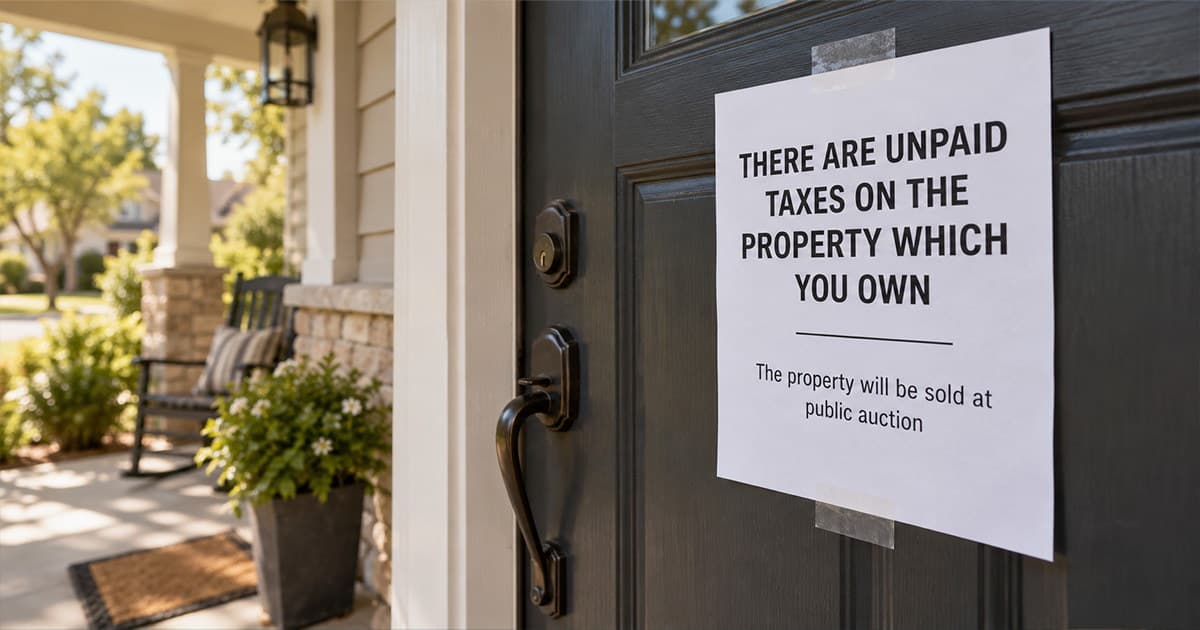
A house on a quiet street changes owners on a weekday morning, in a courthouse room, for a fraction of what it is worth. Nobody defaulted on a mortgage. Nobody filed for divorce. The property simply stopped receiving a tax payment, and a clock running for more than two years finally ran out. Florida tax deed sales are the least understood forced transfer in the state, and the slowest — which is exactly why so few should ever happen.
This is a guide to that clock — where it starts, who can stop it, and what a buyer actually receives when the gavel falls. Every deadline below comes from Chapter 197 of the Florida Statutes.
A tax certificate is not a tax deed
The most common confusion here is treating the two as one thing. They are separate events, years apart.
When real property taxes go unpaid, the county does not sell the house. It sells a tax certificate — an interest-bearing claim against the property for the unpaid amount. Under s. 197.432 each certificate "shall be awarded to the person who will pay the taxes, interest, costs, and charges and will demand the lowest rate of interest," bidding down from a ceiling of 18 percent per year (s. 197.172). If nobody bids, it "shall be struck to the county at the maximum rate of interest allowed by this chapter."
Buying a certificate makes you a creditor, not an owner. Most are simply redeemed and the holder collects interest, with a floor: s. 197.472(2) requires "a mandatory minimum interest of an absolute 5 percent" on the face value where earned interest falls below it. The tax deed is a separate, later, optional step only a certificate holder can start.
The clock: November 1 to the courthouse steps
Delinquent property taxes in Florida move on a fixed statutory schedule, and the run from a missed bill to a sold house is longer than most people assume.
| Step | When | Authority |
|---|---|---|
| Taxes due and payable | November 1 | s. 197.333 |
| Taxes become delinquent | April 1 following the year assessed | s. 197.333 |
| Tax certificate sold | On or before June 1, or the 60th day after delinquency, whichever is later | s. 197.402 |
| Holder may apply for a tax deed | Any time after 2 years have elapsed since April 1 of the year the certificate was issued | s. 197.502(1) |
| Sheriff notifies the legal titleholder | At least 20 days before the sale | s. 197.522 |
| Public auction by the clerk | As advertised | s. 197.542 |
Count it forward. A bill unpaid in November 2026 becomes delinquent in April 2027, is certificated by June 2027, and cannot support a tax deed application until April 2029 at the earliest. Add the title search, advertising and notice period, and the auction lands closer to three years after the first missed payment than two.
Redemption: the owner holds the last word
For that entire stretch, the owner can undo it. Section 197.472(1) is blunt: "A person may redeem a tax certificate at any time after the certificate is issued and before a tax deed is issued." Not before the application. Not before the advertisement. Before the deed.
That makes tax deed redemption the widest escape hatch in Florida's distressed-property law, and it is why a tax deed sale reads as a signal of absence rather than insolvency. Someone who knows the bill exists and can pay it almost always does. The houses that reach auction are disproportionately the ones where nobody is opening the mail — and s. 197.522 is unsentimental about it: "the inability of the sheriff to serve notice on the legal titleholder shall not affect the validity of the tax deed issued pursuant to the notice."
Owners still living in the home have another option worth knowing: s. 197.252 allows a homestead owner to defer payment where the taxes exceed 5 percent of prior-year household income, or 3 percent for applicants 65 and older.
What an opening bid includes — and why homestead changes everything
An opening bid is not "the back taxes." It bundles the certificate amount, other outstanding taxes, interest and the clerk's costs — and on one category of property it includes something far larger. Section 197.502(6)(c) provides that a bid on property "assessed on the latest tax roll as homestead property shall include, in addition to the amount of money required for an opening bid on nonhomestead property, an amount equal to one-half of the latest assessed value of the homestead."
Half the assessed value, added to the floor. That provision is the difference between a house selling for the price of its unpaid taxes and one priced out of a bargain sale entirely — and it is worth putting a number on.
Across the single-family and condominium properties tied to estate-related filings in our four active Florida counties, 77.6 percent are classified homestead on the tax roll, against 58.2 percent of all single-family and condo properties in those counties. On the homestead ones, half the assessed value is a median of $107,516 — a statutory floor with no relationship to the tax owed, existing purely because of how the property is classified.
The same classification does quieter work on the other side of the ledger. Florida's Save Our Homes cap holds assessed value below market value for as long as the classification runs, and on these long-held properties the gap is wide: homestead parcels here are assessed at a median of 59.4 percent of just value. Non-homestead parcels in the same sample sit at a median of 100.0 percent, with 64.6 percent at exactly just value — the same pattern behind the finding that estate-linked homes have been owned twice as long as the county norm.
Here is the part that matters: both protections hang on the same hook. The cap and the opening-bid uplift each key off homestead classification, and classification is tied to an owner who lives there. Section 196.011(10)(a) requires refiling "when the ownership changes in any manner" and prompt notice whenever "the status or condition of the owner changes so as to change the exempt status of the property." An owner who fails to give it is exposed to back taxes "for any year within the prior 10 years" plus 15 percent interest per annum and a 50 percent penalty, secured by a recorded lien under s. 196.161.
So when a homeowner dies and no surviving spouse or qualifying heir keeps the classification alive, three things happen quietly on the next roll: assessed value can snap toward full market value, the six-figure cushion under any future tax deed sale disappears, and an unreported exemption begins accruing a clawback. None of it generates a court filing.
The counties differ enough that a single statewide instinct will mislead you in both directions:
| County | Properties in sample | Classified homestead | Assessed as % of just value | Median half-of-assessed uplift |
|---|---|---|---|---|
| Pinellas | 1,538 | 80.6% | 48.1% | $82,420 |
| Lee | 1,183 | 75.1% | 67.1% | $110,874 |
| Sarasota | 1,070 | 80.5% | 71.2% | $121,023 |
| Collier | 616 | 69.8% | 54.0% | $162,779 |
Pinellas County shows the deepest assessment compression and the smallest cushion; Collier County the reverse. Lee County and Sarasota County sit between. Three caveats belong with these figures: assessed value is a roll classification, not an appraisal; the uplift is one component of an opening bid, not the whole of it; and classification is read off the latest tax roll rather than anyone's legal homestead rights. A fuller breakdown of how estate and distress cohorts differ is in what the property records show.
What survives a tax deed
This is where buyers get hurt. The rule in s. 197.552 is sweeping — no right, interest, restriction or covenant survives a tax deed — but carries one expensive exception: "a lien of record held by a municipal or county governmental unit, special district, or community development district, when such lien is not satisfied as of the disbursement of proceeds of sale."
Government liens survive. Code enforcement liens, municipal utility liens and special district assessments can ride straight through a tax deed onto the new owner. A private mortgage generally does not survive, which is what draws people to these sales — but that is a conclusion to verify against the record in each case, not a rule to assume, and a different mechanism from a lis pendens in a mortgage foreclosure.
Separately, s. 197.573 preserves restrictions and covenants running with the land — use limitations, building requirements, covenants against nuisances — "to the same extent that it would be enforceable against a voluntary grantee." Covenants creating a debt or lien do not survive, and forfeitures, rights of reentry and reverters are "destroyed and shall not survive."
The auction, the deposit, and the surplus
The sale itself is fast and unforgiving. Property is sold at public auction by the clerk of the circuit court. The high bidder "shall post with the clerk a nonrefundable deposit of 5 percent of the bid or $200, whichever is greater, at the time of the sale," and if the balance, documentary stamp tax and recording fees go unpaid "within 24 hours, excluding weekends and legal holidays, the clerk shall cancel all bids" (s. 197.542). The pacing resembles how a mortgage foreclosure auction works, which is why this end of the market suits funded fix-and-flip investors rather than anyone lining up money afterward.
If the sale brings more than the opening bid, s. 197.582 sends the excess first to governmental units for recorded liens and unpaid taxes, then holds the remainder for the former owner and lienholders. Claimants are notified and have 120 days from the date of the notice to file; claims not filed "on or before close of business on the 120th day" are barred. Where none is made, the surplus goes to the former legal owner.
Why the tax deed list is the last place to look for a seller
Everything above describes a process that runs two to three years, notifies the owner repeatedly, can be halted by a payment at any point before the deed issues, and ends in a room anyone can walk into. By the time a property reaches a tax deed calendar the owner has run out of time and control, the price is set by open bidding, and the opportunity is visible to every other bidder at once.
The earlier signals are court filings, and they sit on no auction calendar. A probate opens. A lis pendens is recorded. A landlord files to evict. A dissolution petition names a marital home. In each case an owner still holds title and can still sign — the entire difference between a negotiation and a bidding war. That is the window wholesalers working Florida and investors chasing Florida pre-foreclosure leads compete for, and it opens years before a tax deed application is even permitted.
It is also where the homestead finding stops being trivia and becomes a diligence item. When nobody moves into an inherited house, the classification lapses on schedule and no letter goes out about it — the same silence that lets several heirs inherit one house and leave it in limbo for years. Reading the tax roll alongside the filing shows which estates are quietly losing their cushion.
PocketLeads tracks Florida probate leads, pre-foreclosures, divorces and evictions from county courts in Collier, Lee, Sarasota and Pinellas, with more counties coming — filings on the platform the same day, matched to the property, its owners and its equity position. Start a free trial and work the filing while the owner still owns it.
Frequently asked questions
How long does a Florida tax deed sale take from the first missed payment?
A little over two years at minimum, and in practice closer to three. Taxes become delinquent on April 1, a certificate is sold by roughly June 1, and s. 197.502(1) bars a tax deed application until "2 years have elapsed since April 1 of the year of issuance of the tax certificate." Title search, notice and advertising add months on top.
Can an owner stop a Florida tax deed sale?
Yes, and almost until the end. Section 197.472(1) permits redemption "at any time after the certificate is issued and before a tax deed is issued." Redeeming pays the holder principal plus interest, subject to the mandatory 5 percent minimum in s. 197.472(2), and stops the process.
Does a tax deed wipe out a mortgage?
Section 197.552 provides that no right, interest, restriction or covenant survives a tax deed except a lien of record held by a municipal or county governmental unit, special district or community development district that is unsatisfied when sale proceeds are disbursed. Private mortgages fall outside that exception, but government liens survive — so title on any individual property must be checked against the record, not assumed.
Who gets the money left over after a tax deed sale?
Under s. 197.582 surplus goes first to governmental units holding recorded liens and unpaid taxes, and the balance is held for the former owner and other lienholders. Those notified have 120 days from the notice to file a written claim, after which claims are barred; if nobody claims it, the surplus goes to the former legal owner.
What happens if nobody bids at the sale?
The clerk enters the parcel on a list titled "lands available for taxes" (s. 197.502(7)). If it stays there three years the land escheats to the county "free and clear," and under s. 197.502(8) all certificates, accrued taxes and liens against it "shall be deemed canceled as a matter of law."