
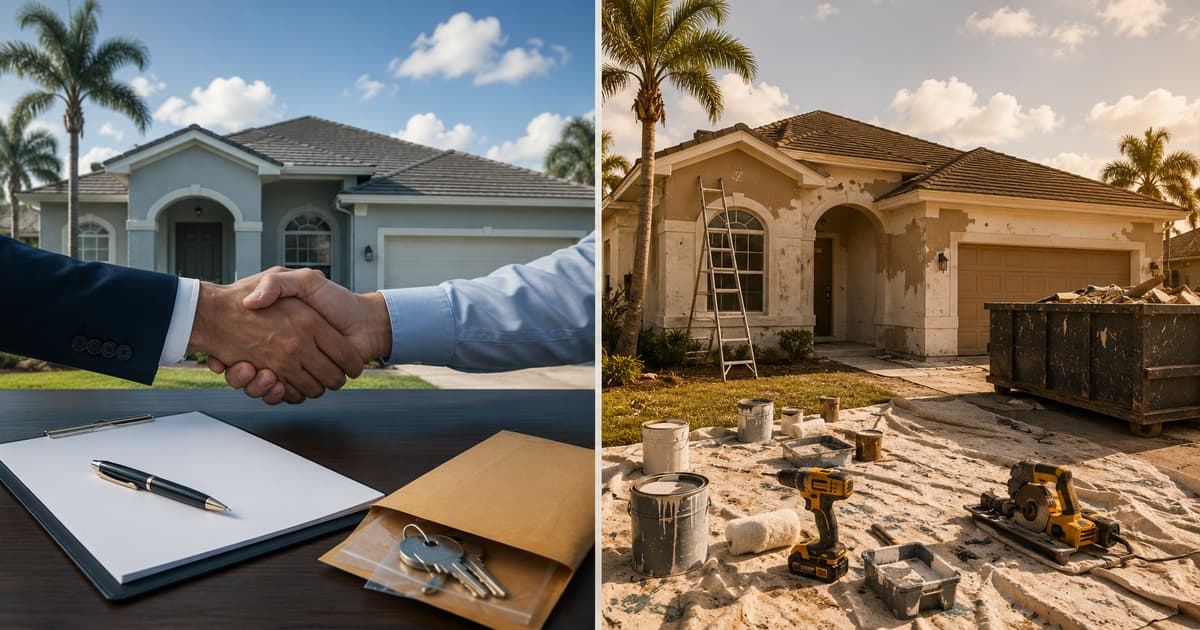
Two Florida investors can look at the same three-bedroom in Cape Coral and see two entirely different deals. One sees a contract to assign and a check at closing in three weeks. The other sees six months, a dumpster, and a resale. The wholesaling vs. fix-and-flip choice usually gets framed as a question of ambition, as though flipping were the grown-up version of wholesaling. It isn't. These are two businesses with different license exposure, different capital requirements, and — most decisively — they work on different houses.
Wholesaling vs. Fix-and-Flip at a Glance
| Dimension | Wholesaling | Fix-and-Flip |
|---|---|---|
| What you actually sell | Your position in a purchase contract | The house itself, after renovation |
| Capital at risk | Earnest money and marketing | Full purchase price plus rehab — 61.1% of U.S. flips were bought all-cash in Q1 2026 |
| Timeline | The seller's original closing window | 165 days from purchase to resale, on average |
| Where the profit comes from | The spread between your contract price and what an end buyer will pay for it | The spread between purchase price and resale, minus rehab and carrying costs |
| Primary risk | No end buyer materialises and you cannot perform | Rehab overruns and a long hold eating the spread |
| Florida license exposure | Depends on whether you are acting for yourself or for another — see below | You take title, so you are selling your own property |
The flip figures above are ATTOM's, from its Q1 2026 U.S. Home Flipping Report. Everything else is structural — and the structural differences are where the money is won or lost.
What Florida Law Actually Says About Wholesaling
Start with what the statute books do not contain. Chapter 475 governs real estate brokerage in Florida, and its sections run from Definitions (475.01) to Facsimile signatures (475.5018). Not one mentions wholesaling, wholesalers, assignment of contract, or equitable interest. There is no Florida wholesaling license and no Florida wholesaling exemption. So "is wholesaling real estate legal in Florida" cannot be answered by pointing at a wholesaling statute. It is answered by asking whether what you are doing meets the statutory definition of brokerage.
Under F.S. 475.01(1)(a), a broker is a person who, "for another, and for a compensation or valuable consideration directly or indirectly paid or promised … sells, exchanges, buys, rents, or offers, attempts or agrees to … negotiate the sale, exchange, purchase, or rental of … any real property." The same section reaches anyone who "advertise[s] or holds out to the public … that she or he is engaged in the business of … buying, selling, exchanging, leasing, or renting … real property of others."
Two words carry the weight: for another. The exemption at F.S. 475.011(2) sits on the far side of that same line, covering an entity "which sells, exchanges, or leases its own real property." A fix-and-flip investor lands there without much argument — they take title, so they are selling their own house. A wholesaler's position is more delicate, and it turns on facts no statute can anticipate: how the contract is drafted, what is advertised, and to whom.
Getting it wrong is not a slap on the wrist. F.S. 475.42(1)(a) states that "a person may not operate as a broker or sales associate without being the holder of a valid and current active license therefor" — a felony of the third degree. And there is a quieter penalty that should focus the mind of anyone planning to collect a fee: under F.S. 475.41, "no contract for a commission or compensation … is valid unless the broker or sales associate has complied with this chapter." Land on the wrong side of the line and you can do all the work and still have no valid contract to collect on.
None of this is legal advice, and no article can tell you which side of the line your deal sits on. That is an hour with a Florida real estate attorney — an hour to spend before your first assignment, not after.
Assignment vs. Double Close: What the Exit Costs
Wholesalers exit one of two ways, and the two do not cost the same.
An assignment transfers your contract to the end buyer: one deed goes on record, seller to end buyer. A double close puts you on title first — seller to you, then you to your buyer. That is two deeds, and Florida taxes deeds. The Department of Revenue is explicit: "in all Florida counties except Miami-Dade, the tax rate imposed on documents subject to tax is 70 cents on each $100 or portion thereof of the total consideration" — the rate set by F.S. 201.02(1)(a) — and "deeds are taxable whether recorded or not."
On a $300,000 house, each conveyance carries roughly $2,100 in documentary stamp tax. A double close adds a second taxable deed and a second set of closing costs, purely to keep your spread private from the end buyer. Sometimes that privacy earns its keep. Either way it belongs in your numbers before you sign, not as a surprise at the closing table.
The Flip Math the Headline Number Leaves Out
Florida looks like a good place to flip, and on the headline numbers it is. ATTOM counted 5,529 Florida flips in the first quarter of 2026 — 6.6 percent of all Florida home sales — returning a median gross profit of $75,000 at a 28.3 percent gross ROI. Both figures beat the national medians of $66,000 and 25.4 percent.
Now read ATTOM's own definition of that number, because it is doing a lot of quiet work: gross flipping profit is the difference between purchase price and resale price "not including rehab costs and other expenses incurred, which flipping veterans estimate typically run between 20 percent and 33 percent of the property's after-repair value."
That is not a footnote, it is the whole business. On an illustrative $400,000 after-repair value, ATTOM's own range implies $80,000 to $132,000 of costs the gross figure has not yet absorbed. A $75,000 gross profit is not $75,000 in your pocket — it is the number you start subtracting from. Then add the hold: ATTOM put the average flip at 165 days from purchase to resale, every month of it taxes, insurance and interest working against the spread.
Finally, consider who you are bidding against. Nationally, 61.1 percent of flipped homes were bought all-cash in Q1 2026. In our own back yard it is far more extreme: ATTOM ranked Naples, in Collier County, at 79.2 percent all-cash and Cape Coral, in Lee County, at 77.5 percent — among the highest shares in the country. Competing for renovation candidates in Southwest Florida means assuming the offer across the table is cash and needs no lender. That one fact pushes plenty of newer fix-and-flip investors toward wholesaling for a season — not as a lesser strategy, but as the one their balance sheet can actually run.
Which Lead Types Actually Support Which Strategy
Here is the part the strategy debate almost always skips. Whether a deal can be flipped, wholesaled, or neither is decided less by your temperament than by the debt sitting on the property.
Across the four Florida counties PocketLeads covers — Collier, Lee, Sarasota and Pinellas, with more counties coming — roughly 5,000 leads sourced from county court records since 1 May 2026 look like this:
| Lead type | Share with no recorded mortgage | Median property value | Median year built |
|---|---|---|---|
| Probate & estate | About 6 in 10 | ~$393,000 | 1987 |
| Eviction-linked | About 6 in 10 | ~$290,000 | 1983 |
| Pre-foreclosure | About 1 in 5 | ~$342,000 | 1988 |
| Divorce | About 1 in 5 | ~$431,000 | 1993 |
Aggregate figures for active leads across Collier, Lee, Sarasota and Pinellas, 1 May – 14 July 2026. "No recorded mortgage" means no mortgage is recorded against the property in the county records — a recording fact, not a statement about any owner's finances.
Read the second column first, because it decides which exits are open to you at all. Where roughly four in five properties carry a recorded mortgage — Florida pre-foreclosure leads and divorce filings — the loan payoff sets a floor under the price. The balance must be cleared at closing, or the lender must agree to take less, and that floor frequently sits above the number a flip needs once rehab comes out of a 70-percent-of-ARV offer. That is the unglamorous arithmetic behind why so many pre-foreclosure deals end as assignments, listings or short sales rather than deep-discount renovations — and why buying a pre-foreclosure directly from the owner is a negotiation about the payoff before it is a negotiation about the house.
Invert the column and the picture inverts with it. Among Florida probate leads and the properties behind eviction filings, about six in ten carry no recorded mortgage, and the houses are older — median build years of 1987 and 1983. Both conditions a renovation play needs show up at once: room on title to absorb a discount, and a house that genuinely wants the work.
None of this says a probate house can't be wholesaled or a pre-foreclosure can't be flipped. Plenty are, both ways. It says the odds are not evenly spread — so if you run one playbook, source the lead type that feeds it. That is the argument for wholesalers working Florida court filings rather than buying whatever list turns up that week.
Choosing the Right Strategy for the Deal in Front of You
Wholesale when you don't have the capital (or the appetite) for a 165-day hold, you have real cash buyers who answer the phone, and the spread still survives an honest — not a hopeful — after-repair value.
Flip when you can fund the purchase and another 20 to 33 percent of the after-repair value in costs, you can carry the hold without it forcing a bad listing decision, and the house actually needs the work. If you're still assembling that pipeline, how to find fix-and-flip deals in Florida walks the sourcing workflow step by step.
And a few ways to lose either way: marketing a property you do not have under contract; assigning a contract that contains an anti-assignment clause; promising a seller a closing date you cannot deliver; and — the classic — buying the after-repair value you wish were true rather than the one the comparable sales support.
Frequently Asked Questions
Is wholesaling real estate legal in Florida?
Florida has no statute that licenses, bans, or defines wholesaling — Chapter 475 contains no section on it. What the chapter does define is brokerage: under F.S. 475.01(1)(a), a broker is someone who negotiates a sale for another for compensation. Whether a given wholesale deal falls inside that definition turns on how the contract is written and what is advertised. Ask a Florida real estate attorney about your structure.
Do I need a real estate license to wholesale in Florida?
There is no "wholesaling license" in Florida. The risk runs the other way: if what you do meets the statutory definition of brokerage, F.S. 475.42(1)(a) makes operating without a license a third-degree felony, and F.S. 475.41 makes a contract for compensation invalid unless the person was licensed when the service was performed — so the fee may be uncollectible.
What is the difference between an assignment and a double close?
An assignment transfers your contract to the end buyer, so one deed is recorded. A double close puts you on title first, producing two. Florida charges documentary stamp tax of 70 cents per $100 of consideration in every county except Miami-Dade, so the second conveyance carries its own tax and closing costs — roughly $2,100 on a $300,000 house.
How much does a Florida flip cost beyond the purchase price?
ATTOM puts the median Florida flip's Q1 2026 gross profit at $75,000 (28.3 percent gross ROI), but defines gross profit as the purchase-to-resale difference excluding rehab and other expenses — which it notes veterans estimate at 20 to 33 percent of after-repair value. On a $400,000 ARV that is $80,000 to $132,000 the headline number has not yet absorbed, before 165 days of average holding costs.
Which motivated seller leads are best for wholesaling versus flipping?
It tracks the debt on the property. In our four Florida counties, about four in five pre-foreclosure and divorce properties carry a recorded mortgage, so the payoff balance limits how far the price can fall — which often favours an assignment. About six in ten probate and eviction-linked properties carry no recorded mortgage and were built in the 1980s, giving both the discount headroom and the renovation need a flip requires.
Work the Leads That Fit Your Strategy
PocketLeads delivers motivated seller leads sourced from Florida county court records — probates, pre-foreclosures, divorces and evictions — across Collier, Lee, Sarasota and Pinellas, with more counties coming. Filings reach you the same day, with property, owner and equity detail attached, so you can tell a wholesale deal from a flip before you pick up the phone.
Get Started Free — or see PocketLeads for wholesalers.