
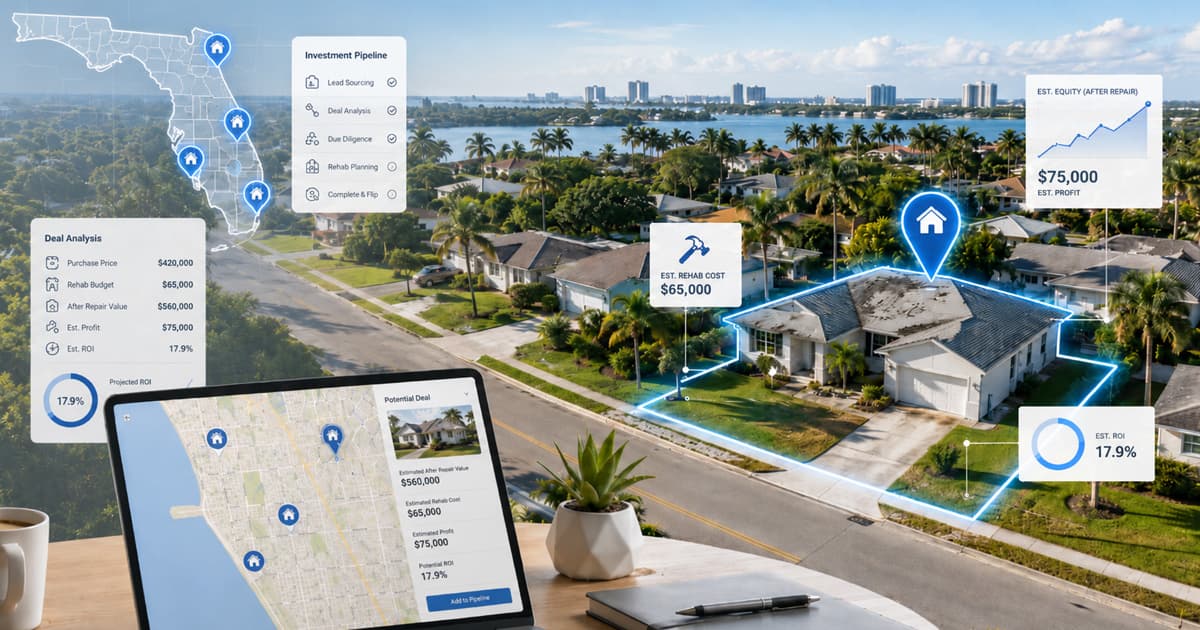
A Florida flip is won on the day you buy it, not the day you list it. In the first quarter of 2026, the median flipped home in Florida returned $75,000 in gross profit — a 28.3 percent gross return, comfortably ahead of the national median of $66,000 and 25.4 percent, according to ATTOM. Those returns went to investors who bought below retail, and buying below retail starts long before an offer is written. Learning how to find fix-and-flip deals in Florida is mostly a sourcing problem: the best candidates rarely reach the open market, and the investors who win them are reading court records, not listing feeds. Here is the workflow, step by step.
Start With the Math: Your Buy Box and the 70% Rule
Before hunting for a single property, set the number that will filter every candidate: your maximum allowable offer. The industry's standard screen is the 70% rule — pay no more than 70 percent of a property's after-repair value (ARV), minus the cost of the repairs, a guideline documented by national fix-and-flip lender Lima One Capital. As a formula: MAO = (ARV × 0.70) − repair costs. For example — and this is an illustration, not a market quote — a home that will be worth $400,000 renovated and needs $60,000 of work prices out at ($400,000 × 0.70) − $60,000 = $220,000. The 30 percent band is not all profit: it has to absorb closing costs, financing, insurance, taxes, utilities, and the resale commission.
That discipline matters more now than at any point in nearly two decades. ATTOM's year-end report put the typical 2025 flip at a 25.5 percent gross return — the lowest since 2008 — and the first quarter of 2026 brought the first margin improvement in almost two years. In a thin-margin market, the difference between a profitable flip and a break-even one is almost always the purchase price. Write your buy box down: target neighborhoods, resale price band, maximum rehab depth, and minimum spread. Every lead you touch from here gets measured against it.
Why Off-Market Sourcing Wins in Florida in 2026
Flips made up 8 percent of all U.S. home sales in the first quarter of 2026, and the competition behind that number is professional: 61.1 percent of flipped homes nationally were bought with cash. Two Southwest Florida metros sit at the very top of that list — Naples, in Collier County, posted a 79.2 percent all-cash share on flip purchases, and Cape Coral, in Lee County, posted 77.5 percent, among the highest in the country. When nearly four out of five competing buyers can close without a lender, you do not win deals by waiting for them to be listed.
Keyword alerts on the MLS — "as-is," "TLC," "cash only" — are a fine baseline, but a listed property is by definition visible to every one of those cash buyers at once. The durable edge is reaching an owner while the motivation exists and before the listing does. Motivation is not guesswork: it shows up in the public record as a court filing, often months before a sign goes in the yard. That is the premise behind court-sourced fix-and-flip leads: let the filings tell you who has a reason to sell, then be the first respectful offer they hear.
The Four Court-Record Signals That Surface Flip Candidates
Not every distress signal produces flip-grade inventory. Four filing types consistently do, and each maps to a different acquisition dynamic:
| Signal | What the filing tells you | Flip fit |
|---|---|---|
| Probate & estate filings | An inherited property, often older and often debt-free, with heirs who may prefer cash to a renovation project | Cosmetic-to-moderate rehab; equity headroom for a discount |
| Pre-foreclosure (lis pendens) | A court deadline is running; the owner's alternative to selling is losing the home at auction | Deadline-driven discount; payoff must be verified |
| Eviction filings | A landlord spending time and money in court — sometimes repeatedly on the same property | Tenant-worn condition; classic value-add purchase |
| Divorce filings | Two owners dividing assets under court supervision, frequently including the house | Speed and certainty beat top dollar; two signatures required |
Probate and estate filings
Estate properties are the closest thing Florida has to purpose-built flip inventory. Across the roughly 2,500 active estate leads PocketLeads has indexed in Collier, Lee, Sarasota, and Pinellas since the start of May, the median home was built in 1987, and more than half predate 1990. Roughly 6 in 10 carry no recorded mortgage, and the median market value sits just under $400,000. Read that profile back as an investor: a late-1980s home with dated finishes, no lender on title to complicate a discounted sale, and a resale band deep enough to support a real renovation budget. Heirs — especially out-of-state heirs — are often choosing between managing a contractor remotely and taking a clean cash offer. Florida probate leads reward patience and tact; our probate direct-mail playbook covers the sequencing.
Pre-foreclosures
A recorded lis pendens starts a clock, and that clock is what creates the negotiation. We have indexed more than 1,100 active pre-foreclosure leads across the four counties since the start of May; about 1 in 5 show no recorded mortgage (many of those cases are brought by associations or other lienholders), and the median market value is about $344,000. The mechanics differ from every other signal on this list — the case has to be resolved at closing, which means verified payoffs and a title company that has done this before. Our guide on how to buy a pre-foreclosure home in Florida walks the statutes and the timeline.
Evictions — the tired-landlord signal
An eviction filing is a landlord paying a lawyer to recover their own property. File two or three on the same address and you are watching an owner fall out of love with the rental business in real time. These homes tend to carry exactly the kind of tenant-worn condition — flooring, paint, kitchens — that scares retail buyers and prices in a flipper's discount. Eviction leads are the least crowded of the four signals; our tired-landlord guide covers how to read them.
Divorces
A dissolution case frequently forces the sale of the marital home, and the sellers' priority is usually certainty and speed, not squeezing the last dollar. Two owners must both sign, which rewards clean offers and professional tone. Divorce leads are a volume play — treat them as a steady secondary channel alongside the estate and pre-foreclosure work.
From List to Shortlist: The Screening Pass
A signal is not a deal. The screening pass turns a county's worth of filings into the 20 or 30 addresses actually worth pursuing this month. Work it desktop-first: filter to properties whose resale band fits your buy box, then to owners with enough equity that your discounted offer can physically close — a seller who owes more than your MAO cannot accept it, no matter how motivated they are. Pull sold comps from the immediate sub-market, recent and genuinely comparable, and set a preliminary ARV you would defend to a lender. Band the rehab from age and photos — a pre-1990 home should be assumed to need more than paint until a walkthrough proves otherwise — and only then spend windshield time confirming condition in person. A tight shortlist you actually work beats five hundred addresses you mail once and abandon.
Outreach and the Offer: Mail First, MAO Always
For owners in court proceedings, mail is the channel that respects both the law and the moment — we compared the two approaches in direct mail vs. cold calling. A letter reaches the verified owner at a verified address, and when the owner calls you back, a cold outreach problem has become a warm inbound conversation. From there the discipline is simple to state and hard to keep: walk the property, firm up the rehab number, re-run the MAO, and offer at the MAO — not at a number reverse-engineered from the asking price. Your offer's value is not the figure; it is the certainty: cash or hard-money proof of funds, no financing contingency, a close date measured in weeks.
The clock argues for the same discipline. ATTOM measured the average flip at 165 days from purchase to resale in the first quarter of 2026 — every month of hold is taxes, insurance, and interest working against the spread. The anti-patterns that kill margins are worth naming:
- Paying near-retail because the deal is off-market. Off-market is a sourcing advantage, not a valuation method.
- Wishful comps. If the ARV needs the best sale the neighborhood has ever printed, it is not an ARV — it is a hope.
- Underestimating pre-1990 rehabs. Roofs, panels, and plumbing do not show up in listing photos.
- Skipping the authority check on estate deals. Confirm the person negotiating actually has the power to sell before you spend on inspections.
- One-touch follow-up. Court timelines run for months; a single letter is not a campaign.
Frequently Asked Questions
What is the 70% rule in house flipping?
It is the guideline that an investor should pay no more than 70 percent of a property's after-repair value minus repair costs. On a $400,000 ARV with $60,000 of repairs, that caps the offer at $220,000. The remaining margin covers closing, holding, and selling costs — plus the profit.
Is flipping houses in Florida still profitable in 2026?
The data says yes, with discipline. ATTOM's Q1 2026 figures show the median Florida flip returned $75,000 gross — a 28.3 percent gross return, ahead of the $66,000 and 25.4 percent national medians. But 2025 margins were the thinnest since 2008 nationally, so the profit is being made at acquisition, not on appreciation.
What types of off-market properties make the best flips?
Properties whose owners have a documented reason to sell and enough equity to accept a discount. In our four-county Florida data, estate properties fit best: median build year 1987 and roughly 6 in 10 with no recorded mortgage. Pre-foreclosures add deadline-driven motivation; evictions surface tenant-worn homes with built-in value-add.
How fast do I need to move on a Florida flip candidate?
Faster than the listing. In Naples and Cape Coral, roughly four in five flip purchases were all-cash in Q1 2026 — once a property is publicly listed, you are bidding against that entire pool. Court filings surface motivated owners weeks or months earlier; the investor who makes the first credible, respectful contact usually gets the first serious conversation.
Find Your Next Flip Before It Hits the Market
PocketLeads delivers probate, pre-foreclosure, eviction, and divorce leads from Collier, Lee, Sarasota, and Pinellas counties — sourced from Florida county courts and available the same day, enriched with property, value, and equity data plus skip-traced contact information. See PocketLeads for fix-and-flip investors, or Get Started Free and put this workflow on this week's filings.